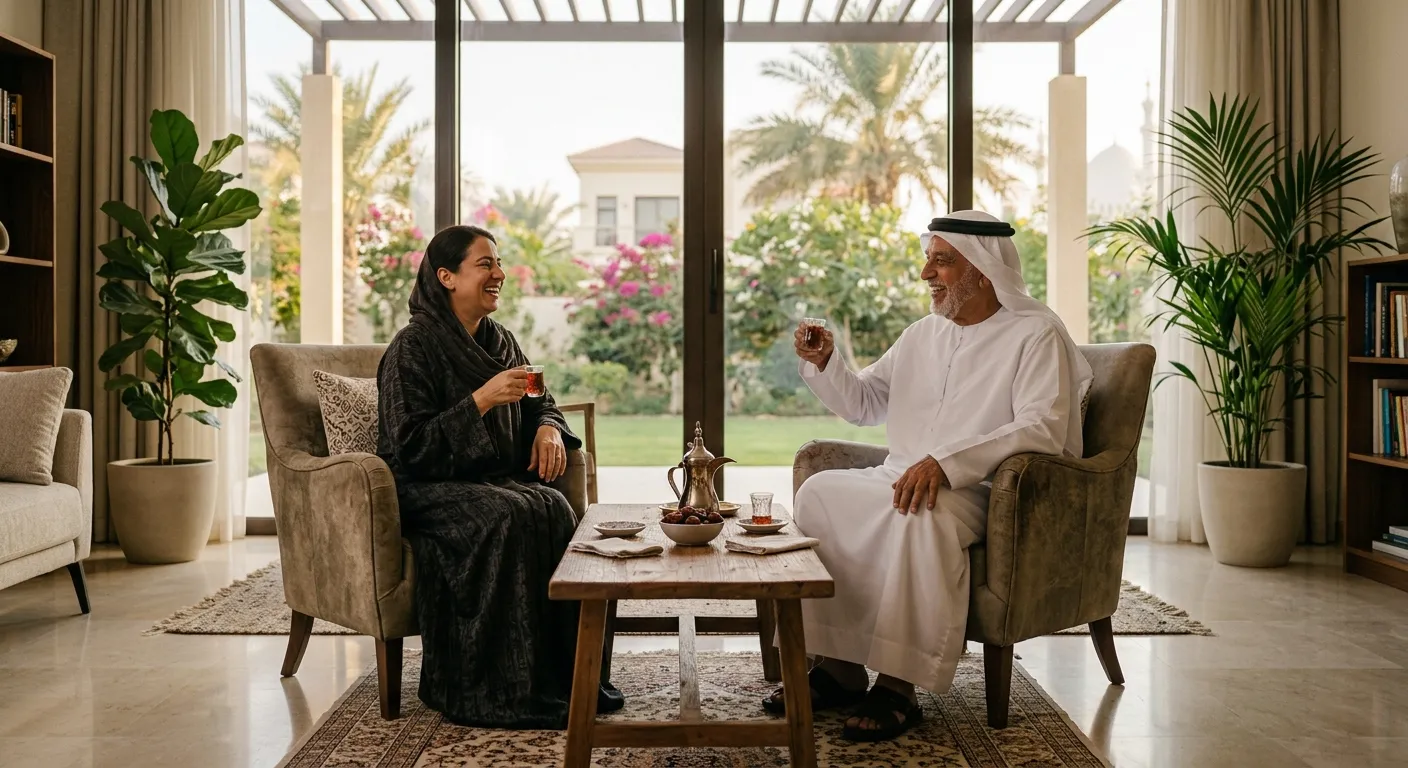
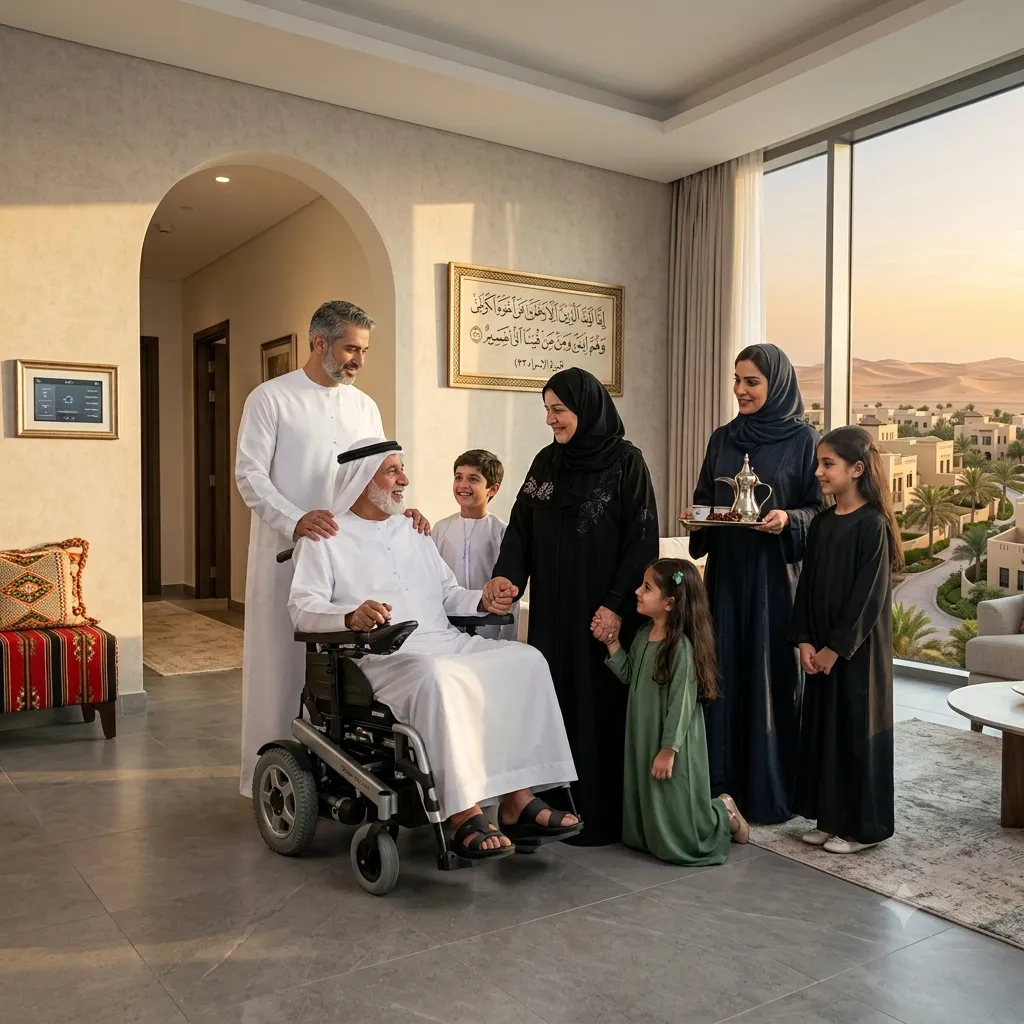
In most GCC households, there was never really a decision to make. When a parent starts needing more help, they stay exactly where they’ve always been: at home, with their children, in the family they raised. Moving them into a care facility is rare here, and it’s often seen as a last resort rather than a normal stage of getting older. That’s not just tradition. Federal Law No. 9 of 2019 codifies the rights of senior Emiratis and reflects a broader national policy built around families caring for their own, and a 2023 policy paper from the Sheikh Saud bin Saqr Al Qasimi Foundation for Policy Research found that 63% of older Emiratis would rather stay in their current home if they need support, with family named as the preferred caregiver by a clear majority across age groups.
Here’s the problem that creates. Most UAE villas and apartments were designed for the family that moved in 15 or 20 years ago, when everyone was able-bodied: climbing stairs without a second thought, stepping over a shower threshold without noticing it’s there. They weren’t designed for a parent with slower balance, weaker knees, or reduced vision. The commitment to keep mum or dad at home is almost universal here. The home actually being ready for it usually isn’t.
This guide walks through what needs to change, room by room, so that commitment holds up in practice and not just as an intention.
Key Takeaways
- UAE and GCC families overwhelmingly prefer to keep aging parents at home, backed by both cultural values and Federal Law No. 9 of 2019.
- The most common mistake is fixing one problem (a grab bar, a stairlift) and assuming the home is now “safe,” while other fall risks remain untouched.
- Bathrooms carry the highest fall risk and should be the first priority in any home assessment.
- Stairlifts and pool hoists let parents keep using parts of the home they’d otherwise give up, not just get around it.
- A whole-home assessment, not a single product purchase, is what actually reduces risk.
Why UAE and GCC Families Choose Home Care Over Care Homes
The preference for home care in this region isn’t sentimental, it’s structural. Caring for elderly parents is treated as a family and religious duty, not an optional kindness, and it shows up in law as much as in custom. The UAE government’s Priority for Senior Citizens page cites Federal Law No. 9 of 2019 on the Rights of Senior Emiratis, along with a National Policy for Senior Citizens built around seven pillars: healthcare, community engagement, financial stability, and independence among them.
It’s worth being honest that this isn’t universal or unchanging. The Al Qasimi Foundation research found a generational gap: while 53–58% of older Emiratis said they’d accept a care facility if they genuinely needed one, only 24–30% of younger Emiratis felt the same, suggesting attitudes are shifting even as the family-first norm holds. Gulf society also carries real stigma around institutional care. It’s often perceived as neglectful or disrespectful toward parents, which puts additional weight on getting home care right rather than treating a care home as the fallback.
Government policy is reinforcing the home-based direction rather than working against it. Abu Dhabi’s “Our Blessing” initiative, launched under Sheikh Mohamed bin Zayed Al Nahyan, funds home upgrades for eligible senior Emiratis, including bathroom and bedroom rehabilitation, ramps, railings, shower chairs, emergency buttons, and anti-slip flooring, specifically so seniors can stay in their own homes safely. The state isn’t building more institutions; it’s funding better-adapted houses.
Put together, the commitment to home care here is genuine and well-supported. What’s missing for most families isn’t willingness. It’s knowing exactly what in the house needs to change.
The Aging-in-Place Mistake Most UAE Families Make
In my work assessing homes across Dubai and the wider UAE, the same pattern comes up constantly. A family calls after something specific has already gone wrong, usually a fall, or a parent who’s told everyone they “can’t manage the stairs anymore.” We install the one thing that fixes that one problem: a grab bar by the toilet, a stairlift on the main staircase. The family is relieved, understandably, and considers the job done.
It rarely is. I’ve walked into homes where a parent has a perfectly installed grab bar and stairlift, and still crosses a wet marble hallway in socks every morning, or steps over an 8cm shower threshold that’s a bigger fall risk than the stairs ever were. Fixing one hazard doesn’t reduce a parent’s overall risk if three others are left untouched. It just moves the story of the next fall to a different room.
That’s why we start every aging-in-place project with a full home assessment rather than a product order. We walk the same path the parent walks every day (bedroom to bathroom, bathroom to kitchen, entrance to living room, and the pool deck if there is one) and look at it the way they experience it, not the way a checklist would. It’s a more honest starting point than “which product do we need,” and it’s the difference between a home that’s actually safer and one that just looks like it’s been renovated.
If you’re planning changes for a parent moving in or aging in place, start with an assessment rather than picking a single fix. It’s the single biggest factor in whether the renovation actually works.
Making the Bathroom Safe: The Highest-Risk Room in the House
Bathrooms account for more falls among older adults than any other room, and UAE homes have a specific version of this problem: polished marble and tile floors that look elegant and become genuinely dangerous the moment they’re wet. If you only address one room, make it this one.
The upgrades that matter most:
- Walk-in or curbless showers remove the step-over threshold entirely, which is one of the single biggest fall triggers in a bathroom.
- Raised, comfort-height toilets reduce the strain of sitting down and standing up, paired with correctly positioned grab bars. Height and placement matter more than people expect; the Dubai Universal Design Code specifies grab bars at 840–915mm for a reason, not as an arbitrary guideline.
- Shower seats let a parent who tires standing wash safely without rushing.
- Non-slip flooring, especially replacing or treating existing marble. This is a genuinely UAE-specific issue rather than a generic aging-in-place tip, given how common polished stone floors are here.
- Toilet support arms and, for parents at higher risk, disabled toilet alarms with an emergency call button. This is the same category of feature Abu Dhabi’s home-upgrade program funds directly, which tells you how seriously it’s taken at a policy level, not just a design one.
We cover the full specification breakdown, including exact code-compliant measurements, in our accessible and handicap toilets service in UAE if you want the technical detail. For a broader look at bathroom accessibility overall, see our accessible homes overview.
Solving the Stairs Problem: Stairlifts for Multi-Level Villas
A lot of UAE villas put every bedroom upstairs, which creates a genuinely difficult decision when a parent’s mobility declines: move their bedroom downstairs (not always possible, or something they want), or find a way to make the stairs safe.
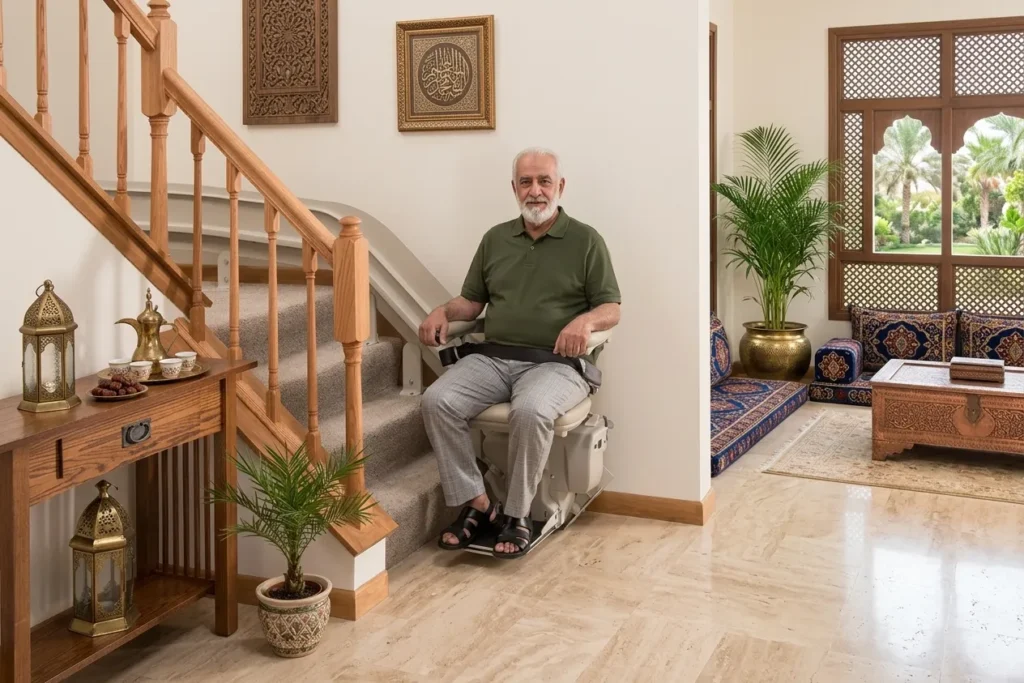
A stairlift or a stair chair is usually the more realistic answer, and the right type depends entirely on the staircase:
- Straight stairlifts suit a single, unbroken flight of stairs. They’re the more affordable option because the rail is a standard length rather than custom-built.
- Curved stairlifts are engineered around staircases with landings or turns, which is common in larger UAE villas. Every rail is custom-manufactured to that specific staircase.
- Wheelchair Platform lifts are worth considering instead if the parent uses a wheelchair rather than walking with support.
Expect a few standard safety features regardless of type: battery backup for continued use during a power outage, obstacle sensors that stop the lift automatically if something’s in the way, and a swivel seat that lets the parent dismount facing the landing rather than twisting toward the stairs. Because every staircase is different, a proper quote should always start with a free home survey rather than a price given over the phone. We’ve written more on assessing stair accessibility in UAE homes if you’d like more context before that visit.
Keeping the Pool Part of Their Life: Pool Hoists and Lifts
This part of aging in place gets skipped in almost every guide we’ve seen, which is a shame, because for a lot of UAE villa families it matters more than people expect. A parent who swam regularly for decades often stops entirely once mobility declines, not because swimming stopped being good for them, but because getting in and out of the pool safely became the barrier. The pool itself becomes something they walk past instead of use.
A pool lift or hoist solves exactly that, and the right setup depends on the pool and how often it’ll be used:
- Portable pool lifts need no permanent installation and can be moved or stored when not in use, a good fit for families who want flexibility or share the pool with other uses.
- Fixed pool lifts are anchored to the pool deck and always available, better suited to a parent who swims regularly and wants zero setup each time.
- Overhead track systems run along a ceiling or fixed rail and suit villas where deck space is limited.
Whatever the type, check for weight-rated slings and swivel seating as the baseline safety features. Installation is more straightforward than most families assume: typically same-day for a portable unit, a single day for a fixed one, so it’s rarely the major construction project people picture.
The Rest of the House: Entrances, Hallways, Bedrooms, and Lighting
The changes below don’t get the same attention as a stairlift or pool hoist, but in a whole-home assessment they matter just as much, often more, because they affect every single trip through the house, not just one.
- Entrance ramps: a step at the front door or garage entry is a daily obstacle. Portable ramps suit renters or households that want flexibility; custom ramps make more sense for an owned villa where the entrance won’t change. If you’re specifying slope or dimensions, our wheelchair ramp slope guide covers the exact ratios.
- Handrails wherever there’s a change in floor level, not only on staircases. A single step down into a sunken living room is an easy thing to overlook until it isn’t.
- Doorway and hallway width: worth checking now even if a walker or wheelchair isn’t needed yet, since widening a doorway later is a bigger job than planning for it during other renovations. Our wheelchair door size guide has the standard clearances.
- Bedroom setup: bed height that makes standing up easier, clear turning space around the bed, and a call button or phone within reach at night.
- Lighting: brighter, glare-free lighting through the main path, plus a night light along the route to the bathroom. It’s one of the cheapest changes on this list and one of the most effective at preventing night-time falls.
- Flooring throughout the home, not just the bathroom. Our guide to accessible flooring in the UAE covers what to look for beyond the marble-and-tile combination most villas start with.
What This Looks Like in Practice: A Real Villa Renovation
We recently worked with a family whose starting point was a familiar one: a parent who was independent but increasingly unsteady in the bathroom, in a villa where the bathroom hadn’t been touched since it was built. Rather than installing a single grab bar and calling it done, we assessed the full space (flooring, threshold, fixture heights, and lighting together) and rebuilt it around how the parent actually used it day to day: curbless shower, comfort-height toilet with correctly positioned grab bars, non-slip flooring, and a shower seat. You can see the full before-and-after case study here.
The outcome wasn’t just a safer bathroom. It was a parent who stopped needing someone standing nearby every time they used it. That’s the actual goal of aging-in-place work: not just fewer hazards, but more independence.
Frequently Asked Questions
Is it common to care for elderly parents at home in the UAE?
Yes. It’s the strong cultural and legal norm across the UAE and wider GCC. Federal Law No. 9 of 2019 sets out the rights of senior Emiratis within a family-centered care model, and research shows a clear majority of older Emiratis prefer to stay in their own home with family as their primary caregiver.
What home modifications help elderly parents age in place safely?
The highest-priority changes are usually bathroom modifications (walk-in showers, raised toilets, grab bars, non-slip flooring), a stairlift for multi-level homes, entrance ramps, hallway handrails, and improved lighting. The right combination depends on the individual home and the parent’s specific mobility needs, which is why a home assessment should come before any single purchase.
Do I need a stairlift if my parent can still climb stairs slowly?
Not necessarily right away, but it’s worth planning for before a fall forces the decision. A home assessment can flag whether the stairs are currently a manageable risk or already a priority.
Can a pool lift be installed without major construction?
In most cases, yes. Portable pool lifts need no permanent installation, and fixed units typically take a single day to install. Neither requires the kind of construction project most people assume.
How do I know which changes my parent’s home actually needs?
A professional home assessment is the most reliable way to find out. It looks at the full path a parent takes through the house, rather than reacting to whichever hazard caused the most recent close call.
Making the Commitment Work in Practice
Choosing to keep a parent at home is already the harder, more demanding path, and in the UAE, it’s also the path families are expected to take. The house they live in shouldn’t be the reason that commitment becomes unsustainable. A whole-home assessment, rather than a single product bought after a scare, is what actually turns “we want them to stay with us” into a home that supports that decision safely for years, not months.
Book a free aging-in-place home assessment with Flex Access and we’ll walk your parent’s home with you, room by room, before recommending anything.