
Tactile Studs: Stainless Steel Warning Studs Supplied and Installed in the UAE
Flex Access supplies and installs tactile studs across Dubai, Abu Dhabi and the UAE, in SS316 and SS304 stainless steel, drill-fit or self-adhesive, made to the 4mm height limit of the Dubai Universal Design Code. Order them supply only, or supplied, installed and documented by our team.
Quick Answer
What are tactile studs?
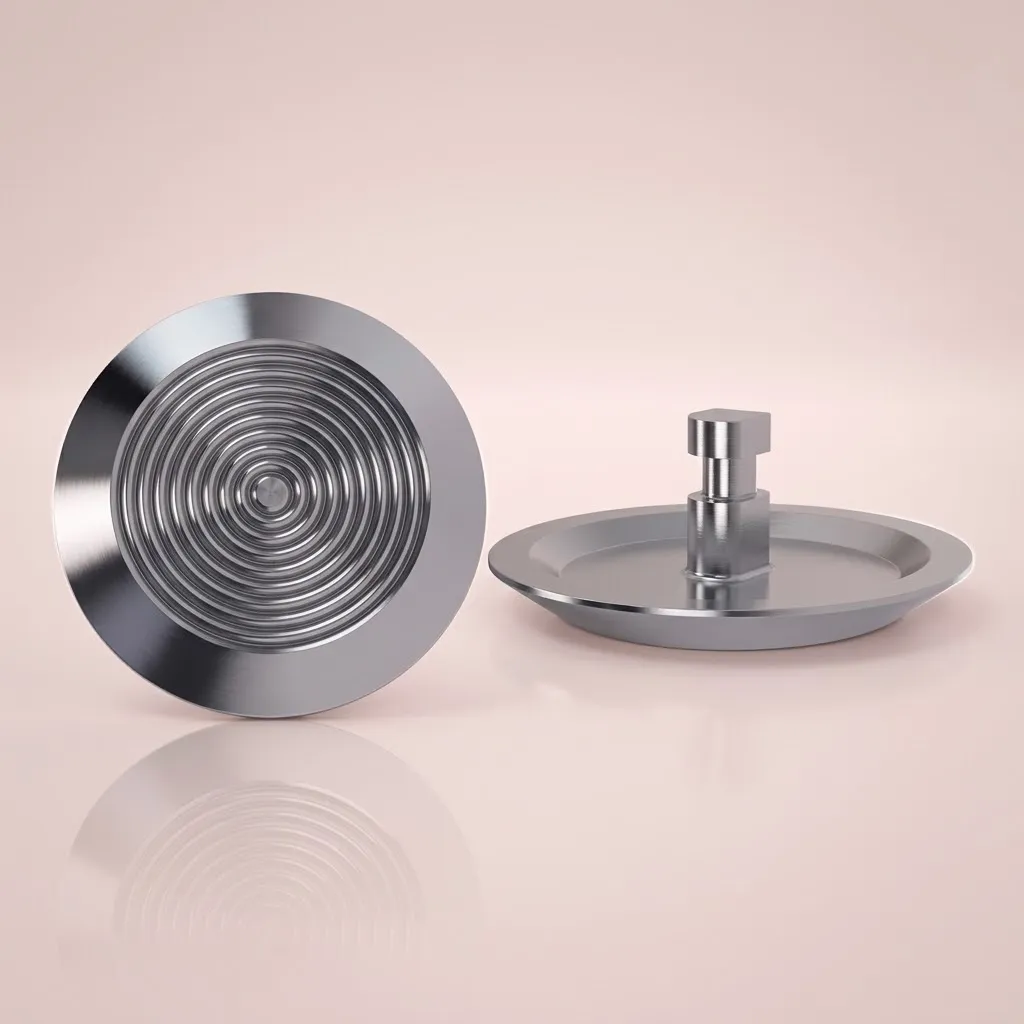
Tactile studs are individual raised studs fixed into a floor in a regular grid to form a tactile warning surface. People who are blind or have low vision detect them by cane or underfoot as a signal to stop and check for a hazard ahead, such as a stair, ramp, lift or crossing. In Dubai, the Universal Design Code requires the warning surface to contrast with the surrounding floor by at least 50 LRV points, with a texture height no greater than 4mm.
Our Range
Our tactile stud range
Every tactile stud in our range is available in SS316 marine grade or SS304 stainless steel, at a 25mm top diameter, 35mm base diameter and 4mm height. Choose the top pattern and fixing method that suit your floor and site.
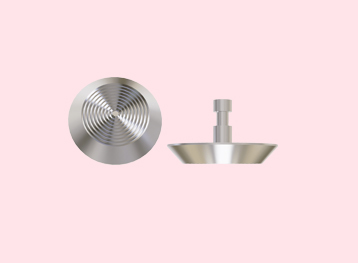
Drill-fit warning stud, concentric ring top
Our most durable tactile warning stud. The stem is set into a drilled or diamond-cored hole and bonded with adhesive. Ring grooves add grip underfoot.
Ask on WhatsApp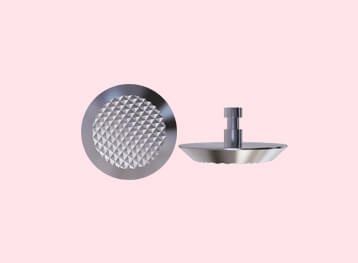
Drill-fit warning stud, crosshatch top
A crosshatch top pattern for extra slip resistance, with the same drill-fit stem as our standard stud.
Ask on WhatsApp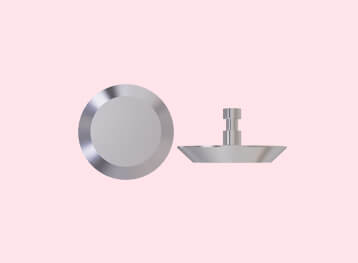
Drill-fit warning stud, plain top
A clean, minimal dome for design-led interiors where a smooth stainless finish matters as much as function.
Ask on WhatsApp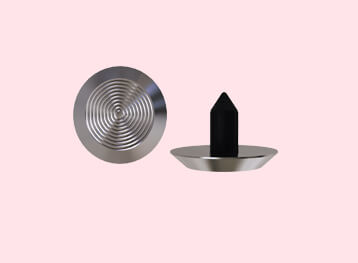
Pressure-fit stud with poly sleeve
A stainless steel stud seated in a polymer sleeve that grips the drilled hole, for a firm mechanical fix that does not rely on adhesive alone.
Ask on WhatsApp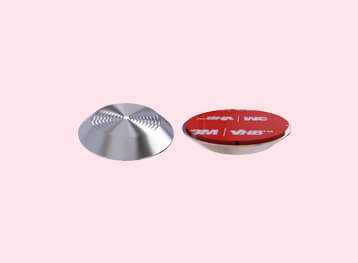
Self-adhesive stainless steel stud
Peel-and-stick tactile studs with no drilling. The fastest way to bring an existing floor into compliance while the building stays open.
Ask on WhatsApp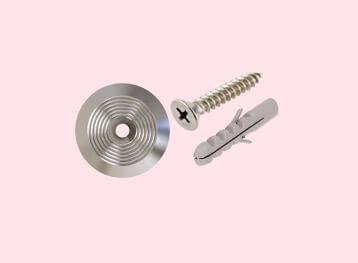
Carpet tactile stud, screw fix
Fixed through carpet with a screw and plug, so the warning surface holds firmly on soft flooring.
Ask on WhatsAppSpecifications
Tactile stud specifications
| Specification | Detail |
|---|---|
| Material | Stainless steel SS316 (marine grade) or SS304. Brass and aluminium on request |
| Top diameter | 25 mm |
| Base diameter | 35 mm |
| Height | 4 mm, the maximum texture height under the Dubai Universal Design Code |
| Top patterns | Concentric rings, crosshatch, plain, carborundum or polymer insert |
| Finish | Brushed or mirror. PVD colours: rose gold, yellow gold, blue, black |
| Fixing options | Drill and adhesive, diamond core and adhesive, drill and pressure fit (poly sleeve), peel and stick, screw and plug (carpet) |
| Suitable floors | Natural stone, porcelain, ceramic, concrete, masonry, terrazzo, timber, vinyl, glass, metal, carpet |
| Contrast (LRV) | Checked on site against your actual floor finish |
| Slip resistance | Included in the product datasheet |
| Warranty | 5 years |

Made to Code
Tactile stud height, spacing and layout to UAE code
A tactile stud only works when it is the right height, laid in the right pattern, in the right place. These are the rules every Flex Access tactile stud supply and layout is checked against.
Maximum texture height, Dubai Universal Design Code
Minimum contrast between warning surface and surrounding floor
Warning band depth, starting at least 300mm from the hazard
Height
Many tactile studs sold internationally are made at 4.5mm to 5mm to suit other standards. Those can be fine elsewhere, but they exceed the Dubai limit. Our tactile studs are made at 4mm, so they meet the Dubai Universal Design Code as supplied.
Pattern and spacing
Warning studs are laid in a regular square grid or diagonal rows across the full width of the walkway, drilled from a template. Freehand drilling gives an irregular pattern that is harder to detect underfoot and is a common reason for failed inspections.
Band size and position
The warning band runs 300mm to 400mm deep and starts at least 300mm from the hazard, at the top and bottom of every stair flight, ramp and level change.
Contrast depends on your floor, not the stud
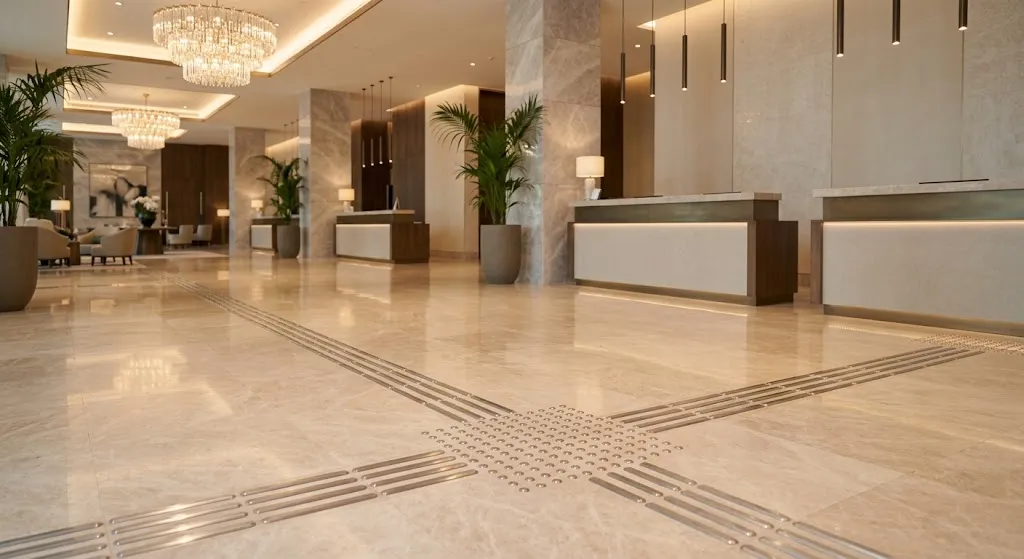
A brushed stainless steel stud that stands out clearly on dark granite can almost disappear on light marble or polished porcelain. The Dubai Universal Design Code requires a minimum 50-point LRV difference between the warning surface and the surrounding floor.
We check contrast against your actual floor finish on site, and recommend a darker PVD finish or an insert-top stud where standard stainless steel would not pass.
Choosing a Grade
SS304 vs SS316 tactile studs
The stainless steel grade decides how your tactile studs look in five years, especially in UAE heat, humidity and coastal air.
| SS304 tactile studs | SS316 tactile studs | |
|---|---|---|
| Corrosion resistance | Good | Higher, marine grade |
| Outdoor and coastal sites | Not recommended | Recommended |
| Pool decks and wet areas | Not recommended | Recommended |
| Controlled indoor spaces | Suitable | Suitable |
| Cost | Lower | Higher |
For outdoor walkways, beachfront properties, pool areas, metro and transport sites, we specify SS316. For air-conditioned interiors such as offices and service centres, SS304 is a sound, lower-cost choice.
Fixing Methods
Pin-type vs self-adhesive tactile studs
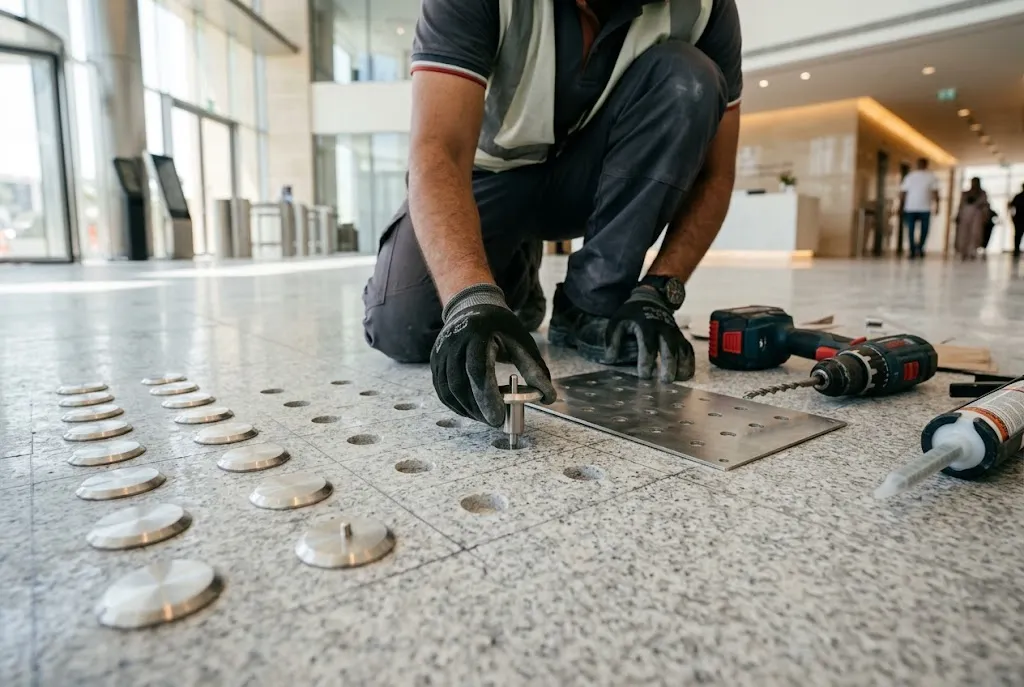
Pin-type (drill-fit)
- Stem set into a drilled hole with adhesive or a poly sleeve
- Highest durability, mechanically anchored
- Suitable indoors and outdoors
- Requires drilling
- Best for high-traffic, outdoor and permanent installations
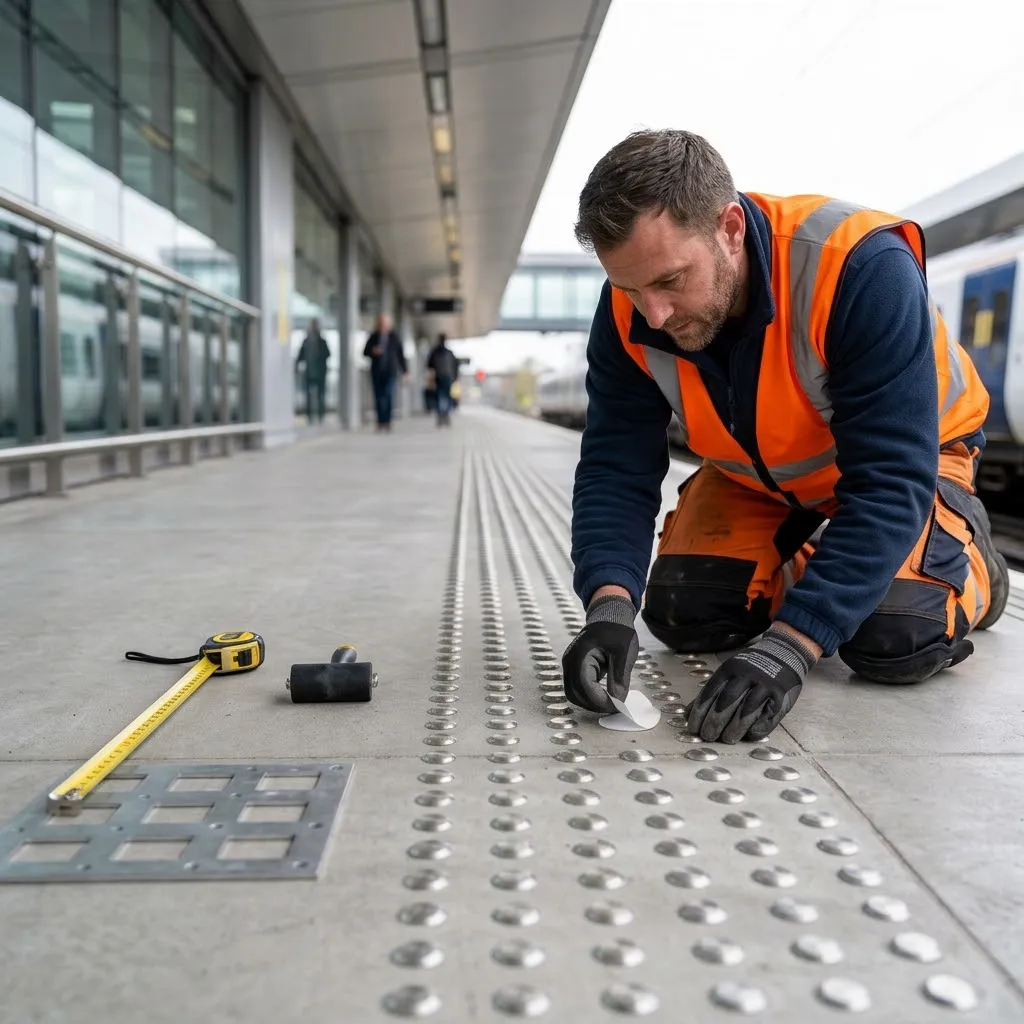
Self-adhesive
- Peel and stick onto a cleaned, primed floor
- Good durability indoors with proper surface preparation
- Limited outdoor use in UAE heat
- No drilling, minimal disruption
- Best for occupied buildings and fast retrofits
Both methods depend on correct layout and surface preparation. See our tactile installation service for how we fix each type.
Where They Go
Where tactile warning studs are required
Tactile warning studs mark the points where a person with a visual impairment needs to stop and check.
Stairs
Top and bottom of every flight
Ramps
Top and bottom of each ramp
Lifts and escalators
In front of every landing
Crossings
Pedestrian crossings and kerb ramps
Platform edges
Metro, bus and any unprotected drop
Entrances
Building entrances and reception points
We supply and install tactile studs for government service centres, real estate and typing offices, malls, hospitals, hotels, schools, metro and transport facilities, and residential developments across all seven emirates.
Right Product
Tactile studs vs tactile tiles vs tactile strips
Choose tactile studs
When you want to keep an existing premium floor, such as marble or granite, and add a discreet, durable warning surface without re-tiling.
Compare the full tactiles range →Choose tactile tiles
When the floor is being laid new or re-tiled, or for outdoor walkways where the tactile surface should be part of the paving.
View tactile tiles and plates →Add tactile strips
Strips form the directional guidance route, and studs mark the warning points at the end of it. Most projects need both.
View tactile strips →Supply Options
Supply only, or supplied and installed
Supply only
For contractors with their own installation teams. We supply tactile studs to your specification, with datasheets and samples for submittal.
Supply and install
You provide the layout. We supply the studs, install them to the approved plan and inspect before handover.
Audit-led turnkey
We audit the site, design the tactile layout to code, handle material approval, supply, install and deliver the compliance documentation.
Submittal pack, with every order
Case Study
Tactile studs installed at a healthcare facility in Abu Dhabi
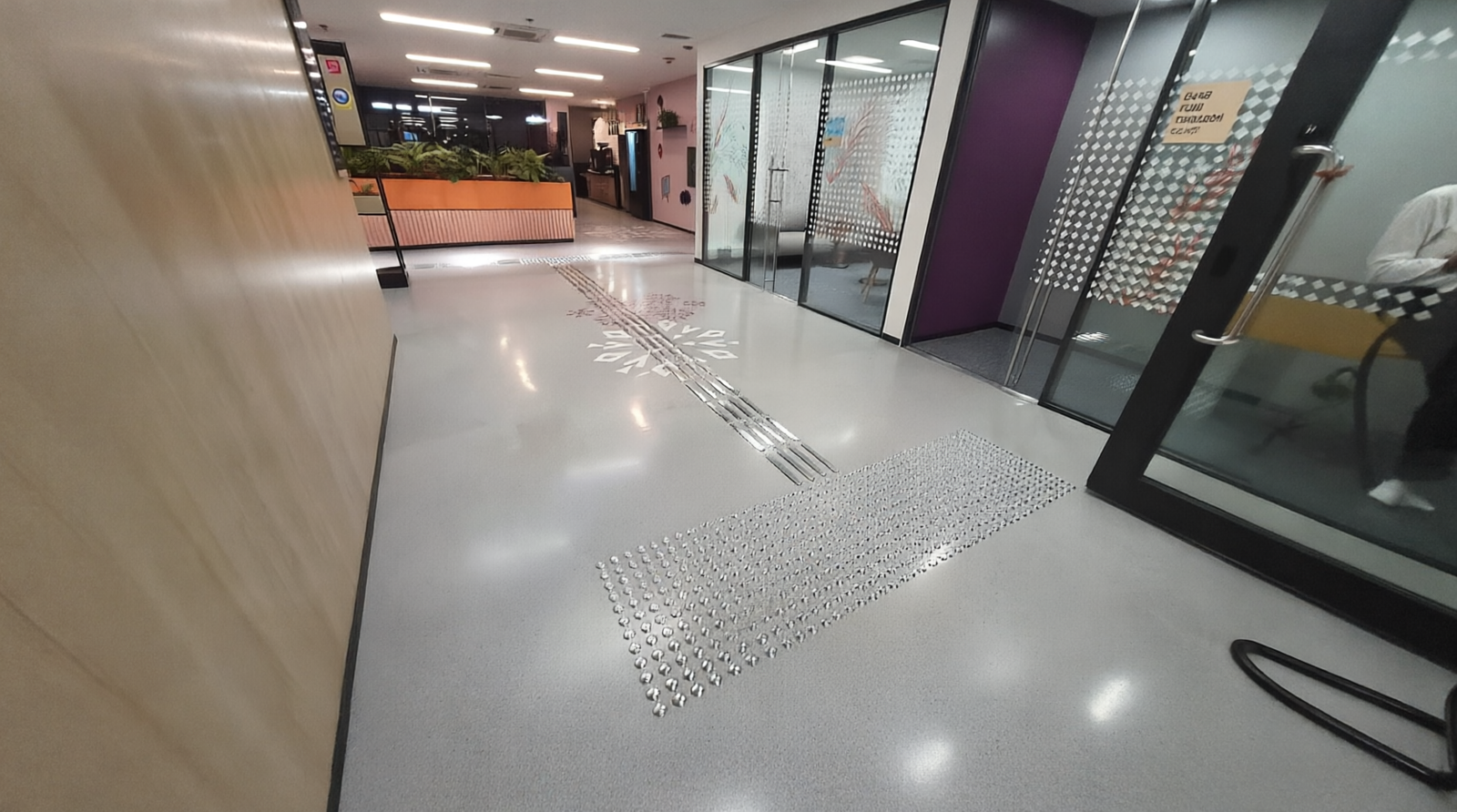
The challenge
A busy healthcare facility needed a complete tactile route from the entrance to reception and ward corridors, with patients and staff using the building throughout the work.
Our solution
We audited the route, mapped every stair and lift lobby, and installed stainless steel tactile warning studs at each hazard, planned together with Braille signage at all patient-facing doors.
The result
A continuous, code-checked tactile route that patients with visual impairments can follow from the front door to the wards, installed without closing the facility.
Planning a project with tactile studs?
Send us your drawings or book a free site assessment. We will confirm quantities, grade and finish for your floor.
Frequently Asked Questions
Tactile studs FAQs
What are tactile studs used for?
Tactile studs form warning surfaces that tell people who are blind or have low vision to stop and check before a hazard, such as a stair, ramp, lift, escalator or road crossing.
Are stainless steel tactile studs slippery when wet?
Plain polished stainless steel can be slippery when wet. That is why tactile warning studs use concentric ring, crosshatch or insert tops that add grip. For wet areas and pool decks we recommend insert-top studs in SS316. Slip data is included in the product datasheet.
Should I choose SS304 or SS316 tactile studs?
Choose SS316 for outdoor, coastal, pool and high-humidity locations, because it is marine grade and resists corrosion better. SS304 is suitable for controlled indoor spaces and costs less.
What height should tactile warning studs be in Dubai?
The Dubai Universal Design Code limits tactile surface texture height to 4mm. Many studs on the market are made at 4.5mm to 5mm for other standards. Our tactile studs are made at 4mm, so they meet the Dubai limit as supplied.
Can tactile studs be installed on marble without damaging it?
Yes. Drill-fit studs need only small, precisely drilled holes made with a template, and self-adhesive studs need no drilling at all. Both keep the existing marble or granite floor intact.
Do self-adhesive tactile studs last outdoors in UAE heat?
Self-adhesive studs perform best indoors. Outdoors, high surface temperatures can weaken adhesive bonds over time, so we recommend drill-fit SS316 studs for exterior walkways and areas in direct sun.
How many tactile studs do I need?
It depends on the width of each hazard, the depth of the warning band and the stud spacing. We confirm exact quantities in a quantity takeoff after the site assessment or from your drawings.
Can you supply tactile studs only, without installation?
Yes. We supply tactile studs to contractors with their own teams, with datasheets and samples for submittal and approval.
What warranty do your tactile studs carry?
Our tactile studs carry a 5-year warranty.

Written By
Nouh Aqra
Accessibility Consultant and Managing Director at Flex Access, with more than 10 years of experience delivering accessibility and mobility solutions across the UAE, including tactile installation and wayfinding projects reviewed against the Dubai Universal Design Code and Federal Law No. 29 of 2006.
Need tactile studs specified, supplied or installed?
Get a datasheet, samples or a free site assessment for tactile studs anywhere in the UAE.