
Nouh Aqra
Accessibility Consultant, UAE
I work with architects, developers, and facility managers across the UAE to close the gap between what accessibility compliance looks like on paper and what it actually requires in a built space. My focus is the Dubai Universal Design Code, the Abu Dhabi International Building Code, and Federal Law No. 29 of 2006 — applied at project level, not referenced in footnotes.
Accessibility that works in practice, not just on the drawing
The most common problem I find across UAE projects is not a building that has no accessible toilet, no ramp, or no tactile system. It is a building that has all three — finished to a professional standard, clearly marked on the architect’s drawings — and failing on specifics that determine whether a wheelchair user can actually use the space.
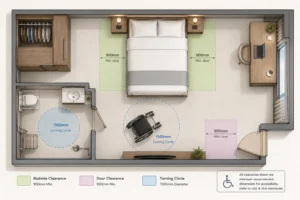
A grab bar installed 80 mm above the code height. A turning circle that was 152.5 cm on plan and 138 cm in the room because a pedal bin was stored there. A ramp slope of 1:9 that meets no standard anywhere in the UAE. These are not theoretical problems. I see them in facilities that passed visual inspection and carry a compliance certificate.
My work at Flex Access is to bridge that gap. I review accessible toilet design, ramp specifications, tactile guidance systems, accessible stair requirements, and complete accessible routes for architects, developers, facility managers, and property owners who need to know exactly what UAE code requires — not in broad terms, but at the level of specific dimensions, load ratings, and fixture positions.
“A box ticked on a drawing is not the same as a space that works for the person it was designed for. My job is to close that difference.”
What I cover in UAE accessibility
Every area below is reviewed against the applicable UAE code — not general best practice, but the specific standard that governs your building type and emirate.
Accessible Toilet Design
Turning circles, grab bar heights and load ratings, alarm system requirements, changing table provisions, and door specifications — reviewed against the Dubai Universal Design Code and Abu Dhabi IBC Section 609.
Wheelchair Ramp Specifications
Slope ratios, cross-slope limits, landing dimensions, handrail heights and extensions, edge protection, and surface requirements. UAE code allows a maximum 1:12 gradient; many installed ramps exceed it.
Platform Lifts and Stairlifts
Selection, specification, and compliance review for vertical platform lifts, inclined lifts, and stairlifts — covering indoor and outdoor installations in residential, commercial, and hospitality settings.
Tactile Guidance Systems
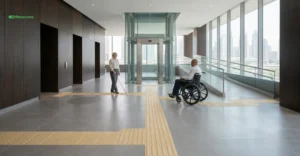
Tactile walking surface indicators for visually impaired users — including directional and warning blister tiles, colour contrast requirements, and placement logic under UAE code.
Accessible Stair Design
Riser and going dimensions, nosing profiles, handrail continuity and extensions, and tactile warning at stair heads — reviewed to Dubai Universal Design Code and Abu Dhabi IBC standards.
Full Accessible Route Compliance
The accessible route to a toilet, lift, or entrance matters as much as the feature itself. I review the complete path of travel: arrival, entrance, corridor, lift, and destination — for gaps a single-element review misses.
How a compliance review works
A straightforward four-step process designed for architects and facility managers who need a clear answer, not a report full of caveats.
Who I work with
Drawing-stage compliance review before submissions and fit-out sign-off.
Pre-handover inspection and gap reporting across residential and commercial projects.
Ongoing compliance reviews and retrofit specifications for existing built assets.
Residential and commercial accessibility assessments for private homes and investment properties.
Full accessible route and guestroom reviews for hotels across Dubai and Abu Dhabi.
Public building accessibility reviews aligned to Federal Law No. 29 of 2006 requirements.
Hospitals and clinics reviewed to mandatory accessible toilet and route standards.
Malls, arenas, and attractions reviewed for UAE code-compliant accessible provision.
Codes and frameworks I work with
Every review I carry out is grounded in the primary UAE regulatory documents — not secondary summaries or general international guidance.
Accessibility guides for UAE professionals
The most common problem is not a building that lacks an accessible toilet. It is a building that has one — professionally finished and clearly signposted — that fails on the specifics that determine whether it can actually be used.
There is a ramp at the entrance, professionally finished, neatly edged, clearly visible. The ramp slope is 1:9. No UAE code allows that. A technical guide to what the correct specifications actually are.
The UAE has made a measurable commitment to making its built environment inclusive. This guide covers exactly what stair design must look like to meet the applicable UAE standards for riser height, nosings, handrails, and tactile warnings.
Need a compliance review for your project?
I work with architects, facility managers, and developers across Dubai and Abu Dhabi. If your project has an accessible toilet, a ramp, a lift, or any accessible route element that needs to meet UAE code, contact us at Flex Access and let me review it properly.