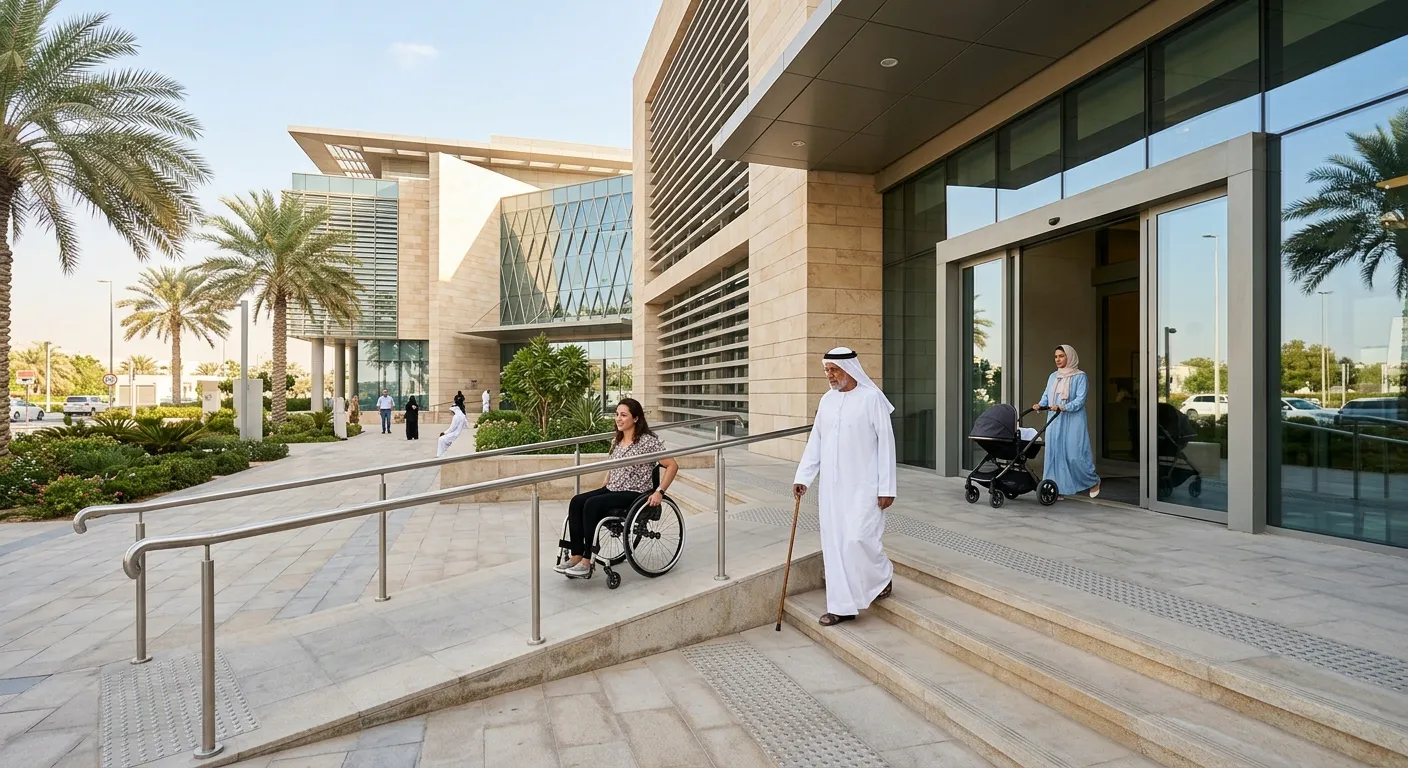
The Sahel Rating System is Abu Dhabi’s official accessibility rating for the built environment. It measures how easily everyone can reach, enter and use a building, a public space or a whole community, and gives it one of four ratings: Accessible, Adaptable, Inclusive or Exemplar.
The system is run by the Department of Municipalities and Transport (DMT). It was announced in March 2025 after a one-year pilot, and it is mandatory, starting with new developments.
This guide explains what Sahel is, who it serves, how the four levels are scored, how certification works, and what it means if you own, design or manage property in Abu Dhabi.
Sahel at a glance
| Question | Answer |
|---|---|
| System Name | Sahel (Sahl) Accessibility Rating System |
| Who runs it | Department of Municipalities and Transport (DMT), Abu Dhabi |
| When it launched | Announced March 2025, after a one-year pilot |
| Is it mandatory | Yes, starting with new developments |
| Where it applies | The whole emirate: Abu Dhabi City, Al Ain, and Al Dhafra |
| What it rates | Buildings, public spaces, and communities |
| Rating levels | Accessible, Adaptable, Inclusive, Exemplar |
| Minimum for a building permit | Accessible, at the design stage |
| Minimum for new government projects | Adaptable |
| Certificate validity | 5 years, then renewal |
| Official building guideline | ADG 41/2024, Abu Dhabi Quality and Conformity Council |
Sahel means “ease” in Arabic, and that word sums up the goal. A place should be easy, safe and effortless to use for everyone, without barriers.
The system is built on the 7 Principles of Universal Design: equitable use, flexibility in use, simple and intuitive use, perceptible information, tolerance for error, low physical effort, and size and space for approach and use.
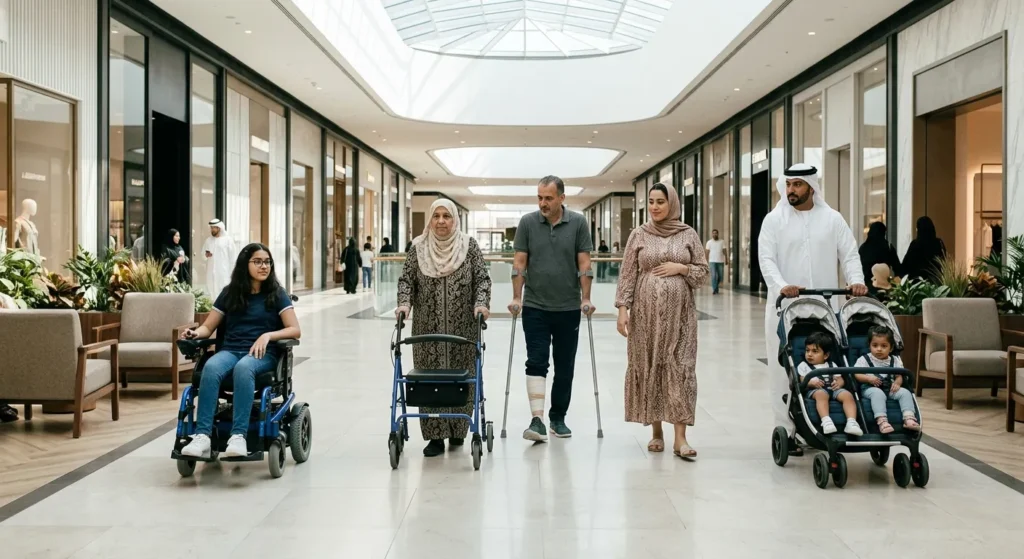
Sahel is not only about wheelchair users. The official Sahel Building handbook names a much wider group of people:
- People with mobility, vision, hearing or cognitive impairments, including neurodivergent people
- Elderly residents and visitors
- Pregnant women, nursing mothers and families with young children
- People with temporary or situational challenges, such as a broken leg or a heavy pram
- People with allergies
- Obese and bariatric people
- People from a foreign cultural background
This matters because it changes who benefits. A ramp, a step-free entrance or a clear sign helps a parent with a stroller as much as a wheelchair user. Sahel treats accessibility as good design for everyone.
The three types of Sahel rating
Sahel uses one set of rules, split into three tiers so each type of place is judged fairly. A building, a park and a master-planned community face different challenges, so each has its own handbook.
| Rating | What it covers | Examples |
|---|---|---|
| Sahel Building Rating | All building types, especially those open to the public. It can also certify homes and heritage buildings. | Offices, malls, hospitals, schools, hotels, government buildings, apartments, villas |
| Sahel Public Realm Rating | Outdoor spaces used on their own, plus the facilities inside them | Parks, plazas, beaches, streetscapes, playgrounds, waterfronts, public toilets, kiosks |
| Sahel Community Rating | Accessibility at the master planning stage, across a whole development | New neighbourhoods and master-planned communities |
The tiers connect. For example, the Public Realm handbook points to the Building handbook for detailed parking rules, and to the Community handbook for where parking should be located. Transport buildings such as airports and bus terminals fall under the Building Rating, not the Public Realm Rating.
The four Sahel rating levels explained
Every Sahel requirement falls into one of three groups, as set out in the Sahel Building Rating guideline:
- Mandatory: the minimum every new project must meet
- Recommended: a step above the minimum that earns credits
- Best practice: the highest standard, which also earns credits
The rating level depends on two things: whether all mandatory requirements are met, and what share of the recommended and best practice requirements the project achieves.
| Level | Mandatory requirements | Recommended and best practice achieved | In plain words |
|---|---|---|---|
| Accessible | 100% | Not required | Meets every mandatory requirement. This is the minimum standard. |
| Adaptable | 100% | At least 30% | Goes beyond the baseline in several areas. |
| Inclusive | 100% | At least 60% | Designed with a wide range of users in mind throughout. |
| Exemplar | 100% | At least 90% | The top tier. Close to every best practice in the system. |
How the score is calculated
The score is the share of applicable requirements a project meets, shown as a percentage. Only requirements that apply to that project count. A building with no swimming pool is not judged on pool access.
The Building handbook gives a worked example. A project has 145 applicable credits and achieves 103 of them at the certificate stage. That is 71%, which is above the 60% threshold, so the building is rated Inclusive.
One detail is easy to miss. In a new building, meeting a mandatory requirement earns no extra credits, because it is expected. It still counts toward the total of applicable requirements. In an existing building being renovated, mandatory items do earn credits, which shows owners exactly where the gaps are.
Which Sahel level is required?
The Sahel handbooks set the required level by who is building:
- Private new projects and renovations should reach Sahel Accessible at the pre-certificate stage to obtain the municipal building permit.
- New government and semi-government projects must reach Sahel Adaptable.
Anything above these levels is voluntary. Inclusive and Exemplar are the levels owners choose to aim for when they want to stand out.
What Sahel assesses: the 11 categories
Sahel looks at far more than ramps and parking. Every project is assessed across 11 categories that follow a person’s whole visit, from arriving to leaving, and even what happens in an emergency.
| Code | Category | What it checks (examples from the Building handbook) |
|---|---|---|
| IID | Inclusive Integrated Design | Planning accessibility from the earliest design stage, with the right experts involved |
| TA | Transportation Access | Accessible parking, cycle parking, drop-off zones, taxi stands, EV charging, transport terminals |
| IC | Interconnectivity and Circulation | Accessible paths, doors, ramps, staircases, escalators, elevators and platform lifts |
| EFE | Ergonomic Furniture and Equipment | Seating, reception counters, ATMs, queuing barriers, controls people need to reach |
| EQC | Environment Quality and Comfort | Thermal comfort, air quality, acoustics, lighting, floor and wall finishes, quiet rooms |
| HC | Hygiene and Care | Accessible toilets, family toilets, baby feeding rooms, accessible showers and bathrooms |
| DA | Digital Accessibility | The building's webpage, apps, digital maps, online feedback and Wi-Fi |
| OC | Orientation and Communication | Signage, tactile walking surface indicators, tactile maps, hearing enhancement systems |
| ESP | Emergency Systems and Procedures | SOS points, areas of refuge, public address systems, evacuation plans for people with access needs |
| CM | Considerate Maintenance | Keeping accessible features working, safe zones during works, user feedback, staff training |
| USSP | Use Specific Special Provisions | Pools, gyms, playgrounds, auditoriums, homes, workplace kitchens, ablution areas and prayer areas |
Two categories surprise most people. Digital Accessibility means a building’s website and apps are part of its rating. Considerate Maintenance means a rating is not a one-time design exercise: features must keep working after handover.
The last category also reflects local life. Accessible ablution areas, shoe racks and prayer areas are specific credits in the Building handbook.
How detailed the requirements get
The handbooks are precise. A few examples from the mandatory requirements in the Building handbook:
- In buildings open to the public, accessible parking and van spaces must be within 50 m of an accessible entrance, path, elevator or ramp.
- In car parks with more than 25 spaces, at least 5% must be family parking and at least 5% ambulant parking.
- A standard accessible off-street parking space must be at least 2,700 mm wide and 5,500 mm long, with a 1,800 mm access aisle.
In the Public Realm handbook, air-conditioned bus shelters must hold a temperature between 24 and 26 degrees Celsius.
How Sahel certification works
Sahel follows a project through its whole life: design, construction and operation. According to the Building handbook, certification happens in four steps.
- Registration and applicability check: The owner registers the project through a digital form on TAMM. DMT’s Sahel team then meets the owner, their Sahel Qualified Professional and the certifying institution to confirm which rating applies and which credits count for that project.
- Pre-certificate (design stage): The team submits an Accessibility Statement, a document that sets out the accessibility features designed into the project. The pre-certificate shows the level the project intends to reach and supports the permit application.
- Certificate (after handover): Once construction or renovation is complete, the project is assessed on as-built drawings, the finished site and operating procedures. Public buildings also need a successful on-site audit.
- Renewal every 5 years: The first certificate is valid for 5 years. To renew it, the owner submits an updated Accessibility Statement, scorecards, maintenance records and user feedback. The assessor then decides what type of review is needed.
The renewal step is what makes Sahel different from a one-time inspection. A building has to stay accessible to keep its rating.
Who is involved in a Sahel rating?
| Role | Who they are | What they do |
|---|---|---|
| Asset owner | The developer or owner of the property | Applies for the certificate and signs the Accessibility Statement. Responsibility only moves when ownership changes, even if the property is leased or managed by someone else. |
| Sahel Qualified Professional (SQP) | A professional trained by DMT who has passed its assessment | Required on every building project. Guides the team through design, construction and renewal, prepares the Accessibility Statement and visits the site at key stages. |
| Accessibility Consultant | An accessibility and inclusive design specialist | Optional, but appointing one earns credits. Advises on solutions that go beyond the minimum. Can also act as the SQP. |
| Accessibility Body | Users with specific needs, advocacy groups, experts, neighbours | Consulted when needed to give first-hand feedback on usability. |
| Assessor | A representative appointed by DMT | Reviews design documents and Accessibility Statements and can carry out on-site audits. |
| Certifying institution | DMT | Runs the system, trains professionals and issues certificates. |
To become an SQP, the handbooks list a recognised bachelor’s degree in architecture, landscape, urban planning or civil engineering, 5 years of professional experience, and DMT’s Sahel training.
Does Sahel apply to existing buildings?
Yes, that is the plan. Sahel applies to new developments first, and DMT has announced that it will be extended to existing buildings and spaces. No date for that extension has been published yet.
The handbooks are already written for both. Each one covers both new developments and renovation projects, with separate credit scores for renovating existing assets.
For existing buildings, Sahel works as a roadmap rather than a pass or fail test:
- Mandatory items earn credits in renovations: This shows the owner exactly which minimum requirements are met and which still need work.
- Phased upgrades are rewarded: A renovation can earn credits for a written timeline showing when each accessibility upgrade will be delivered. Each stage of that plan can then be submitted for rating.
- Users can be part of the process: Consulting an Accessibility Body, made up of people with access needs, earns credits in renovation projects.
The Building handbook illustrates a phased plan with a sample timeline: half of a building’s guest rooms and elevators upgraded within 2 years, all toilet rooms within 3 years, and all elevators within 5 years. It is an example of how a plan can be structured, not a fixed rule.
How Sahel fits with other UAE accessibility rules
Sahel does not replace existing law. It builds on it and rewards projects that go further. The Sahel handbooks reference:
- Federal Law No. 29 of 2006 concerning the rights of people with special needs
- Abu Dhabi International Building Code, 2013, including its occupancy classes and parking ratios
- Abu Dhabi International Accessibility Standards, 2013
- Estidama Pearl Building and Community Rating Systems, Abu Dhabi’s sustainability ratings
- DMT design manuals such as the Abu Dhabi Urban Street Design Manual and the Public Realm Design Manual
The Building Rating is published as Abu Dhabi Guideline ADG 41/2024 by the Abu Dhabi Quality and Conformity Council. It was prepared by a working group of DMT specialists, with representatives from Zayed Higher Organization and Aldar Properties.
What Sahel means for owners, developers and designers
Sahel is built around early planning, and several credits reward it directly. Here is how to approach it:
- Start at concept design: The system is open to projects at any planning stage, but no later than concept design. Accessibility is easier to design in than to add after drawings are approved.
- Appoint your SQP early: Every project needs one, and they steer the Accessibility Statement that your permit depends on.
- Decide your target level. Accessible is the minimum for a permit. If you want Adaptable or higher, plan which recommended and best practice credits you will pursue.
- Check applicability first: Requirements change with building type, occupancy and size, with a threshold at 2,000 square metres. Knowing which credits apply avoids wasted effort.
- Plan for operation, not just handover: Maintenance records, staff training and user feedback all feed into your 5-year renewal.
- For existing buildings, build a phased plan: A written timeline for upgrades earns credits and spreads the cost over time.
How Flex Access helps buildings get Sahel-ready
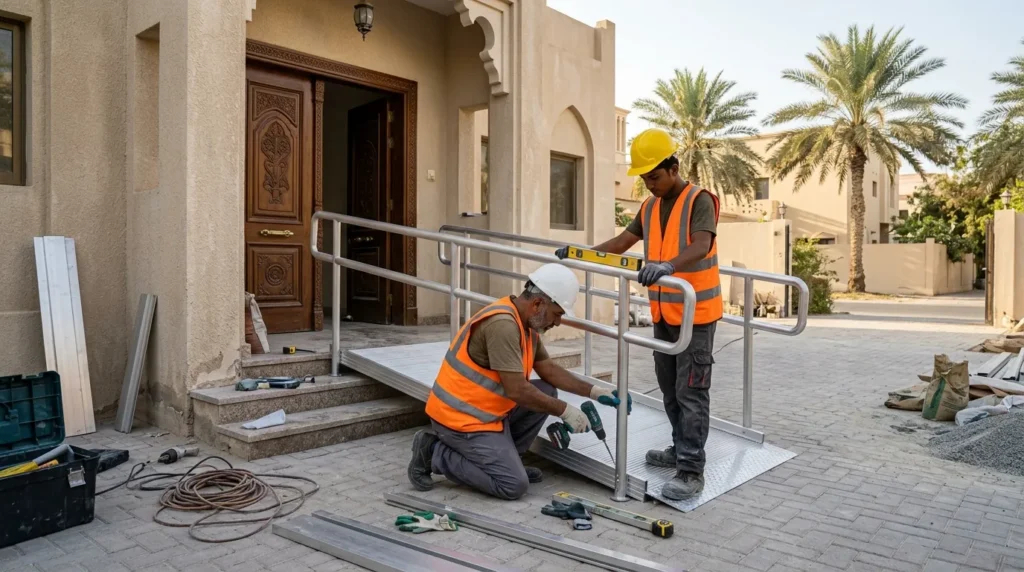
Sahel turns accessibility into something you can measure, and that makes the right partner matter. Flex Access is an Abu Dhabi based accessibility specialist whose team brings over 10 years of experience in accessibility and mobility solutions. It works with developers, consultants, facility managers, government teams and homeowners, and it covers the whole journey from assessment to installation to ongoing maintenance.
Accessibility consulting and audits
Sahel rewards projects that bring accessibility expertise in early, at both design and construction stage. Consulting is at the heart of what Flex Access does. Its consulting and audit services include workplace accessibility audits, hospitality accessibility consulting and DAMJ Award consulting for Abu Dhabi organisations.
Every Flex Access project is reviewed against UAE accessibility law: Federal Law No. 29 of 2006, the Dubai Universal Design Code and the Abu Dhabi International Building Code. The process is clear and the same every time:
- Free on-site assessment to see how the space is really used, room by room
- Written plan and quotation that references the exact UAE code sections that apply
- Build or audit, with audits delivered as a prioritised written report
- Handover walkthrough confirming every fixture and clearance works as planned
For an existing building, a prioritised audit report is a practical starting point for the phased upgrade plan that Sahel rewards in renovations. Sahel sets its own qualification criteria for the formal Accessibility Consultant role, so confirm any appointment with your Sahel Qualified Professional.
Solutions mapped to Sahel categories
Many Sahel credits cover physical features you can specify, install and maintain. Flex Access supplies and installs solutions across most of them:
| Sahel category | What Sahel looks at | Flex Access solutions |
|---|---|---|
| Interconnectivity and Circulation | Ramps, staircases, elevators and platform lifts | Wheelchair platform lifts, stair lifts, handrails, portable wheelchair ramps and custom ramp kits |
| Hygiene and Care | Accessible toilets, showers and bathrooms | Accessible bathroom design and installation |
| Orientation and Communication | Tactile walking surface indicators and signage | Tactile supply and installation, including braille and high-contrast signage |
| Transportation Access and doors | Accessible parking and accessible entrances | Doors and parking solutions, including automated pedestrian doors and vehicle barriers |
| Use Specific Special Provisions | Pools, beaches, playgrounds and homes | Pool lifts and hoists, beach and pool access, inclusive playground equipment, aging in place renovation |
| Considerate Maintenance | Keeping accessible features working after handover | Repair and maintenance for stairlifts, platform lifts and other accessibility equipment |
A Sahel rating is awarded to the whole building, not to individual products. The right equipment, installed and maintained properly, is what helps a building meet the requirements behind each credit.
Recent Flex Access projects
Flex Access reports more than 125 completed projects and has worked with teams at RTA Dubai, Emirates, Rixos and Hilton. Two recent projects show the range of its work:
- Wheelchair platform lift at VOX Cinemas, Yas Mall, Abu Dhabi. Flex Access installed a wheelchair platform lift to give cinema guests step-free access, the kind of vertical access feature Sahel assesses under Interconnectivity and Circulation.
- Accessible villa bathroom in Dubai. Flex Access transformed a villa bathroom into a safe, accessible space that supports independent living, covering the same ground as Sahel’s Hygiene and Care requirements.
Frequently asked questions
What is the Sahel Rating System?
It is Abu Dhabi’s mandatory accessibility rating for buildings, public spaces and communities, run by the Department of Municipalities and Transport. It rates places as Accessible, Adaptable, Inclusive or Exemplar.
What does Sahel mean?
Sahel is the Arabic word for “ease”. The system aims to make every place easy and safe for everyone to use.
Is the Sahel rating mandatory?
Yes. It applies first to new developments. Private projects need at least the Accessible level at design stage to get a building permit, and new government and semi-government projects need Adaptable.
What are the four Sahel levels?
Accessible meets all mandatory requirements. Adaptable adds at least 30% of recommended and best practice requirements, Inclusive at least 60%, and Exemplar at least 90%.
Does Sahel apply to existing buildings?
It is planned. DMT has announced the system will extend to existing buildings and spaces, but no date has been published. The handbooks already include scoring for renovation projects.
How long is a Sahel certificate valid?
The first certificate is valid for 5 years. Renewal requires an updated Accessibility Statement, scorecards, maintenance records and user feedback.
What is a Sahel Qualified Professional?
An SQP is a professional trained and assessed by DMT who guides a project through the Sahel process. Every building project needs one.
Where do I register a project for Sahel?
Projects are registered through a digital form on the TAMM portal.
Does Sahel only cover wheelchair access?
No. It covers mobility, vision, hearing and cognitive needs, plus older people, families with children, pregnant women and anyone with a temporary or situational challenge. It even rates digital access, such as a building’s website and apps.
Get your building ready for Sahel with Flex Access
Sahel is raising the bar for every building in Abu Dhabi. The owners who plan early will find it easier to meet the minimum, aim higher, and keep their rating at renewal.
Flex Access gives you one team from start to finish. That means an accessibility assessment, a written plan that references the UAE codes that apply, the right equipment from its ranges, professional installation and ongoing maintenance.
- Planning a new project? Bring accessibility expertise in at concept design, where Sahel rewards it.
- Upgrading an existing building? Start with an audit and a phased plan that spreads the work over time.
- Running a hotel, workplace or public facility? Get a clear, prioritised report your team can act on.
Book a free assessment or message Flex Access on WhatsApp to talk through your building. Because everyone belongs.
Sources
- DMT: Sahel Rating System announcement
- Abu Dhabi Media Office: Sahel launch
- Khaleej Times: Abu Dhabi launches Sahel system, 21 March 2025
- ADG 41/2024: Abu Dhabi Guideline for Sahel System, Building Rating (QCC)
- Sahel Public Realm Rating System Handbook (DMT, draft)
- Sahel Community Rating System Handbook (DMT, draft)