Key Takeaways
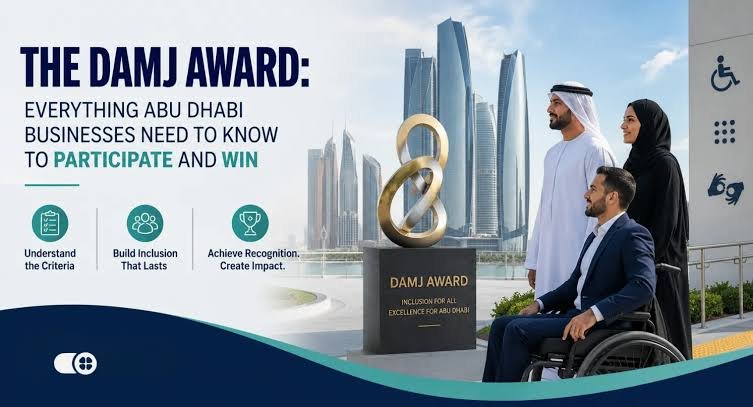
- The DAMJ Award (Abu Dhabi Excellence Award for People of Determination Inclusion) is the region’s first official recognition of institutional inclusion, run every two years by the Department of Community Development.
- Eligibility is broad: Any organisation based and operating in Abu Dhabi for at least two years can apply (private sector needs a valid commercial licence; Accessibility pillar also requires a recent occupancy certificate).
- There are three pillars, Inclusive Services, Inclusive Employment, and Accessibility (Physical & Digital) with 10 categories in total. You can enter up to two categories from different pillars.
- Judges look for evidence of impact, sustainability, and real practice, not just policies. Physical accessibility is assessed against the UAE Universal Design Code.
- The inaugural cycle received 372 submissions; winners were announced in mid-June 2026. The next cycle is expected in 2027, start preparing now.
- Flex Access helps organisations close physical, digital, policy, and documentation gaps so they can submit a competitive application.
Most organisations that want to participate in the DAMJ Award are already doing more than they realise. The problem isn’t effort it’s evidence. They haven’t documented what they’ve built, they haven’t mapped their practices to the award’s criteria, and their physical spaces have gaps they don’t know exist until someone like me walks through the door with a checklist and a flashlight.
The Abu Dhabi Excellence Award for People of Determination Inclusion DAMJ is the first award of its kind in the entire region. It’s not a participation trophy. It’s Abu Dhabi’s formal declaration that inclusion is a performance standard one that government bodies, private companies, and nonprofits are expected to meet, demonstrate, and sustain.
This guide breaks down everything you need to know: what DAMJ is, who qualifies, how it’s judged, and how Flex Access helps organisations close the gaps that cost them recognition.
What Is the DAMJ Award?
DAMJ, Arabic for integration or inclusion is a fitting name for what the award represents. Launched under the patronage of His Highness Sheikh Khaled bin Mohamed bin Zayed Al Nahyan, Crown Prince of Abu Dhabi and Chairman of the Abu Dhabi Executive Council, it was developed as a cornerstone initiative of the Abu Dhabi Strategy for People of Determination a national framework initiated in 2020.
The award is administered by the Department of Community Development (DCD) Abu Dhabi and is held every two years. It’s not simply a certificate to hang in the lobby. DCD’s own description of the award frames it as “a call to action, to innovate and inspire organizations to embrace inclusivity, foster creative solutions, and create a supportive environment where People of Determination can reach their full potential.”
In its inaugural cycle, the DAMJ Award received more than 370 submissions from government, private, and third-sector organisations across Abu Dhabi. That number tells you something important: this isn’t a niche award for specialised disability organisations. Mainstream companies, government departments, and service providers are competing and the ones who prepare properly have a real advantage.
Why does participation matter beyond winning?
Because the application process itself is a structured self-assessment. Even organisations that don’t place will come out with a clear picture of where their inclusion practices stand, what gaps exist, and what needs fixing. That’s valuable in any regulatory environment and in Abu Dhabi’s, it may soon be essential.
Eligibility Criteria, Do You Qualify?
Here’s the question I get asked most often: “Are we even eligible?” The answer, for the vast majority of Abu Dhabi-based organisations, is yes.
According to the official DAMJ eligibility requirements, the baseline criteria are:
- The entity must be based and operating within the Emirate of Abu Dhabi.
- The entity must have been established for a minimum of two years within the emirate.
- Private sector applicants must hold a valid commercial licence.
- For the Accessibility pillar specifically, applicants must also present an active occupancy certificate issued within the past five years by the Department of Municipalities and Transport.
That’s it for the baseline. No minimum staff count. No requirement to have People of Determination currently employed before applying (though employment is an evaluation factor for certain categories). No prerequisite that you’ve won a previous award or reached a certain revenue threshold.
One misconception I encounter regularly: small and medium-sized businesses assuming DAMJ is only for large corporations with dedicated HR departments and purpose-built accessible facilities. It isn’t. Evaluation criteria are applied relative to your organisation’s capacity and sector context. An SME with 15 employees can genuinely compete if they can demonstrate that inclusion is embedded in how they operate, not just mentioned in a policy document nobody reads.
Award Categories and Pillars, Where Does Your Organisation Fit?
The DAMJ Award is structured around three main pillars, which together comprise 10 award categories covering government, private sector, and third-sector organisations.
Pillar 1: Inclusive Services
This pillar recognises entities that deliver innovative, inclusive services that genuinely improve the quality of life for People of Determination. It includes six award categories:
- Best Inclusive Healthcare Service (Private Sector)
- Best Inclusive Education Service (Government Sector)
- Best Inclusive Education Service (Private Sector)
- Best Inclusive Tourism and Recreational Service (Private Sector)
- Best Inclusive Transport and Mobility Service (All Sectors)
- Best Inclusive Service in the Third Sector
If your organisation delivers a service in any of these domains and has made deliberate effort to make that service accessible and equitable, this pillar is worth serious consideration.
Pillar 2: Inclusive Employment
This pillar focuses on organisations that have created work environments where People of Determination can perform their roles in accordance with their abilities. It’s about more than having a disability-friendly hiring policy, it’s about the systems, adaptations, and culture that allow People of Determination to actually thrive at work.
Notably, the category covers People of Determination with all types of disabilities, not just physical or mobility-related conditions.
Pillar 3: Accessibility (Physical and Digital)
This is the pillar that intersects most directly with Flex Access’s work. It honours organisations that have achieved excellence in creating inclusive physical and digital environments, ensuring that People of Determination can access, navigate, and use facilities and information without barriers.
Two categories sit within this pillar: one for the government sector and one for the private sector. And this is where the gaps I see most often live in the physical details that get overlooked during design and construction, and in the digital channels that were never built with accessibility in mind.
You can apply for up to two categories, provided each belongs to a different pillar. Applying for two categories within the same pillar is not permitted.
Evaluation Criteria, What Are the Judges Actually Looking For?
The evaluation framework assesses organisations across several dimensions, depending on which pillar and category they enter. For the Accessibility pillar, where most of our clients focus, judges evaluate two core areas:
Physical Environment
This criterion examines whether an organisation’s facilities are designed and operated according to universal design standards, including the UAE Universal Design Code. Judges assess whether People of Determination can access, navigate, and use facilities comfortably without barriers. This includes but isn’t limited to entrances, corridors, washrooms, parking, signage, emergency systems, and all points of transition between spaces.
Informational and Digital Environment
This criterion looks at whether information and services whether delivered at physical centres, through websites, or via smart applications meet accessibility standards. Signage, digital platforms, printed materials, and customer-facing communication channels all fall within scope.
For the Inclusive Employment pillar, the evaluation looks at whether your hiring frameworks, workplace adaptations, and organisational culture genuinely support employees of determination not just on paper, but in practice.
Strong applications demonstrate:
- Impact: measurable outcomes, not just stated intentions
- Sustainability: practices embedded in institutional strategy, not one-off projects
- Scalability: evidence that what you’ve built can grow and be replicated
- Alignment: clear connection between your efforts and the award’s pillars
Applicants are advised to align their submissions closely with the award’s criteria and provide concrete evidence at each evaluation point. Vague policy language without supporting documentation rarely scores well.
How Flex Access Helps Businesses Become Award-Ready
Here’s something I’ve observed across every sector I’ve worked in: the gap between wanting to be inclusive and being able to demonstrate inclusion is almost always a physical and documentation problem, not a values problem.
Most organisations genuinely want to do right by People of Determination. What they’re missing is the technical roadmap, the specific knowledge of what the UAE’s accessibility standards require, translated into changes they can actually implement in their space, systems, and processes.
That’s precisely where Flex Access steps in.
1. Accessibility Gap Analysis
Before any organisation commits resources to an award application, we conduct a structured accessibility audit of their physical environment and operational practices. This isn’t a general walkthrough, it’s a systematic assessment mapped against DAMJ’s evaluation criteria and the UAE Universal Design Code. We identify what’s compliant, what needs adjustment, and what represents a genuine gap that would cost points under evaluation.
One area that consistently surprises clients: vertical transitions. Accessible stairs with proper handrails, tactile indicators, and compliant dimensions are frequently overlooked. Organisations invest in ramps and then neglect the staircase that serves 80% of their users. The DAMJ accessibility pillar evaluates the full navigable environment, not just the wheelchair route.
2. Physical Environment Upgrades
Once we know what’s missing, Flex Access works with clients to implement the required changes. This spans everything from ramp compliance and accessible parking bays to washroom layouts and wayfinding systems. Doors and parking access are often the first point of failure, automatic doors, turning circles, gradient compliance, and accessible bay proximity to entrances are all evaluated under DAMJ’s accessibility criteria, and all are addressable with the right guidance before the assessors arrive.
3. Policy and Employment Support
For organisations pursuing the Inclusive Employment pillar, Flex Access supports the development of inclusive hiring frameworks, People of Determination employment policies, reasonable accommodation documentation, and the procedural records that demonstrate sustained practice rather than reactive accommodation.
4. Staff Training and Awareness
Judges can tell the difference between an organisation that has trained its people and one that has updated its policy documents. We deliver sensitisation programmes that map directly to DAMJ’s evaluation dimensions, not generic equality training, but specific, sector-relevant content that changes how staff interact with and support colleagues and customers of determination.
5. Documentation and Application Support
Building an evidence portfolio is where many organisations lose marks they’ve already earned. Flex Access helps clients compile, structure, and present their supporting documentation in a way that clearly demonstrates alignment with each evaluation criterion. If you’ve done the work but haven’t recorded it, the judges won’t know.
How to Apply for the DAMJ Award (Step by Step)
The application process runs through the official DAMJ portal at damj.gov.ae. Here’s the process, broken down:
Step 1 – Self-assess your eligibility: Review the criteria above. Confirm your organisation is registered in Abu Dhabi and has been operational for at least two years. For the Accessibility pillar, ensure your occupancy certificate is current.
Step 2 – Create an account on damj.gov.ae: Registration opens the application system and gives you access to the detailed criteria documents for your chosen pillar.
Step 3 – Choose your category: Decide which pillar(s) and category/categories best reflect your organisation’s strongest inclusion efforts. Remember, you may apply for up to two categories, each from a different pillar.
Step 4 – Gather your evidence: This is the most labour-intensive step, and the one most organisations underestimate. Compile documentation of your physical accessibility features, inclusive policies, staff training records, employee data (where relevant), and any outcome metrics that demonstrate impact.
Step 5 – Complete and submit your application form: Fill out the nomination form on the portal, attach your supporting documents, and submit before the cycle’s deadline. DCD has also offered bilingual orientation workshops (Arabic and English) to help applicants understand the criteria in depth. Check damj.gov.ae for the current cycle’s workshop schedule.
Step 6 – Await review: Following submission, your application enters DCD’s evaluation process. For the Accessibility pillar, this may include a site visit component. The award’s board of trustees oversees the overall process.
Step 7 – Recognition: Successful applicants are honoured through official DCD channels and the Abu Dhabi Media Office. Beyond the recognition itself, participation signals to clients, partners, and prospective employees that inclusion is institutional policy — not a brochure promise.
Not sure where your organisation stands before committing to an application? Flex Access offers a pre-application readiness assessment to give you a clear picture before you invest the time.
Frequently Asked Questions
Is the DAMJ Award open to small and medium-sized businesses?
Yes, and this is one of the most common misunderstandings I encounter. The eligibility requirements don’t set a minimum staff count or revenue threshold. Evaluation criteria are applied within the context of your organisation’s sector and capacity. A well-prepared SME that has genuinely embedded inclusive practices has a real chance. Flex Access works with businesses of all sizes on DAMJ readiness.
Do we need to have People of Determination currently employed to apply?
For the Inclusive Services and Accessibility pillars, no. Employment of People of Determination is a central evaluation criterion for the Inclusive Employment pillar specifically. If you’re applying under the Accessibility or Inclusive Services pillars, your primary focus is on the quality and reach of your accessible environment and services.
How long does preparation realistically take?
In our experience at Flex Access, organisations with some existing accessibility infrastructure can prepare a strong application in four to eight weeks. Organisations starting from a lower baseline or those that have built accessibility features but haven’t documented them should allow ten to fourteen weeks. Beginning the process well ahead of the submission window gives you time to implement improvements, not just catalogue existing ones.
What physical accessibility standards must our premises meet?
The DAMJ Accessibility pillar references the UAE Universal Design Code as its primary built-environment standard, along with relevant federal legislation including Federal Law No. 29 of 2006 on the Rights of People of Determination. Flex Access audits client premises against these standards specifically, so you know where you stand before the evaluators do.
Can an organisation that received the DAMJ Award in a previous cycle apply again?
The award runs on a two-year cycle. For current-cycle eligibility rules on previous winners, check the official criteria on damj.gov.ae or contact the DCD team directly at damj@addcd.gov.ae.
What happens after we submit?
Your submission enters DCD’s formal review process. Depending on your category, this may include a site visit or an audit of submitted documentation. DCD has indicated that the evaluation period is followed by a results announcement and recognition ceremony. The waiting period is actually a good time to continue improving the award is designed to drive sustained inclusion practices, not just snapshot compliance.
Does Flex Access manage the application on our behalf?
Flex Access provides the consultancy, auditing, documentation support, and technical guidance. Your organisation submits as the applicant which is the right way to do it, because the award is recognising your commitment and practice. Think of us as the people who make sure you’re presenting the strongest, most accurate version of what you’ve built.
The Difference Between Recognition and Compliance
There’s a version of this conversation where I could tell you to participate in the DAMJ Award simply because it’s good for your brand. That’s true but it’s the wrong reason to start.
The right reason is that Abu Dhabi is moving toward a future where accessibility isn’t exceptional, it’s expected. The DAMJ Award is one of the clearest signals of that direction. Organisations that build genuine inclusion into their operations now their physical spaces, their hiring practices, their digital channels will be ahead of a curve that is only going to steepen.
The award is the recognition. The work is the point.
If you’d like to understand where your organisation stands before the next application cycle opens, get in touch with Flex Access for a pre-application readiness assessment. We’ll walk your space, review your documentation, and tell you exactly what it would take to put forward a competitive submission.