Quick Summary
- An accessible hotel room is a room built to exact code dimensions, not just a bigger version of a standard room: wider doors, clear turning space, grab bars, and an alarm system a guest can reach from the floor.
- In Dubai, hotels must make 10% of all rooms accessible, plus every common area. That is a higher quota than most countries require, including the US.
- Roll-in showers are required in half of all accessible rooms under Dubai’s Universal Design Code, regardless of hotel size. Under ADA, a roll-in shower is only mandatory once a US hotel passes 51 rooms.
- Handicap accessible hotel rooms in Dubai and Abu Dhabi are inspected under a real certification system, Wosool, which gives hotels a graded score (75%+ or 90%+), not just a pass/fail.
- Anyone can technically book an accessible room, but hotels are supposed to hold them back for guests who need the features, and it is considered poor etiquette to take one you don’t need.
- Accessible rooms are sometimes cheaper on booking sites, mainly because of lower demand, not lower quality. We explain exactly why further down.
If you have ever booked what a hotel called an “accessible room” and arrived to find a grab bar bolted at the wrong height, a door that will not stay open, or an alarm cord tied up out of reach, you already know the problem this guide is written to solve. A room can look accessible in a photo, get marked as accessible on a booking site, and still fail the person it was supposedly built for.
I review hotel guestrooms across Dubai and Abu Dhabi for a living. This guide covers what a genuinely accessible hotel room requires under UAE law, exactly how that compares to the American ADA standard most global travelers have heard of, and where hotels quietly get it wrong even when they think they have got it right.
What Is an Accessible Hotel Room?
Quick answer: An accessible hotel room is a guestroom built and fitted to specific legal dimensions so a wheelchair user, an ambulatory disabled guest, or an elderly traveler can enter, move around, use the bathroom, and evacuate independently. It is not simply a larger room with a grab bar added.
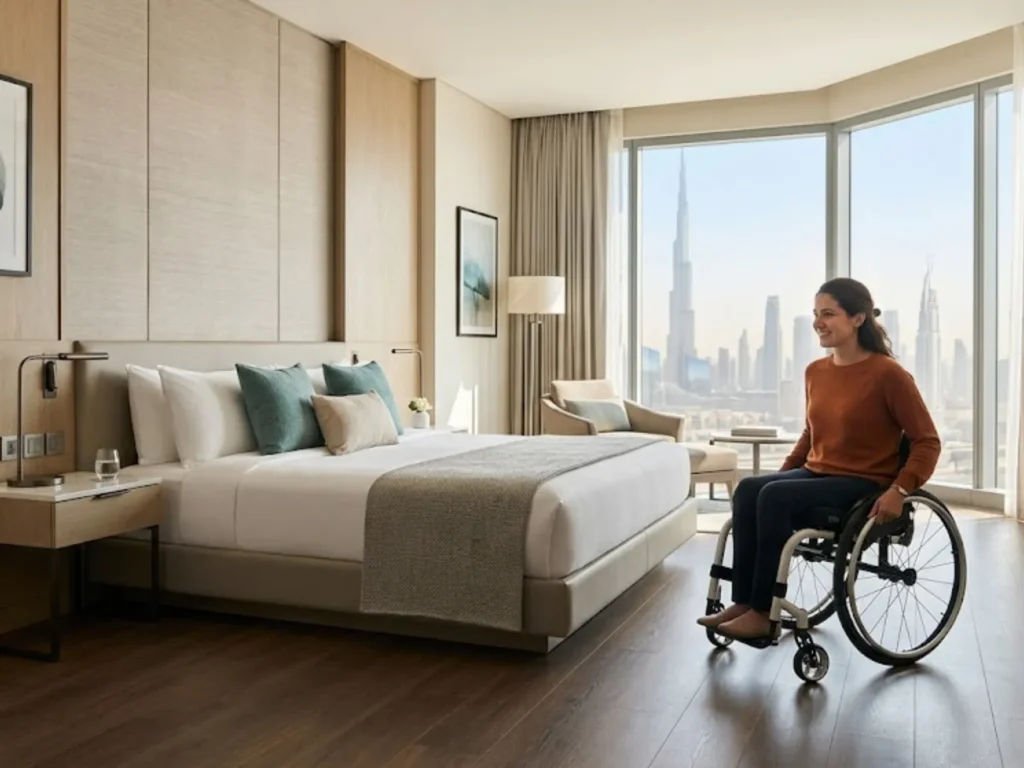
In the UAE, the people this applies to are officially called People of Determination, the terminology used under Federal Law No. 29 of 2006 Concerning the Rights of People of Determination, the federal law that guarantees the right to access public and private spaces, including hotels, without barriers.
You will see several terms used almost interchangeably in search and everyday conversation:
- Accessible hotel room: the correct, current term.
- Wheelchair accessible hotel room: same thing, with the specific user group named.
- Handicap accessible hotel room: an older term, still widely searched, still understood, but not the preferred institutional language in the UAE.
- Disabled room / ADA room: common in the US and older listings; means the same thing in practice.
What actually makes the room accessible is a defined list of features, not a label:
- A door wide enough for a wheelchair to pass through fully open.
- Clear floor space to turn a wheelchair around, not just move in a straight line.
- A bathroom with grab bars at code height, a roll-in shower or a bathtub built to spec, and a way to call for help from floor level.
- Controls, switches, and hardware placed within reach of someone seated.
- A fire alarm that can be seen and heard, not just heard.
Every one of those points has an exact measurement behind it in UAE code. We cover each one below.
The UAE Regulatory Framework: Dubai, Abu Dhabi, and Wosool
Quick answer: Hotel accessibility in the UAE is governed mainly by the Dubai Universal Design Code, the Abu Dhabi International Building Code, and Federal Law No. 29 of 2006. Compliance in Dubai is checked through a real inspection and certification process called Wosool.
Dubai Universal Design Code (UDC)
The Dubai Universal Design Code is the binding technical code for Dubai, not a voluntary guideline. For hotels, it sets out (Sections 5.19, 5.19.1, 5.19.2):
| Requirement | Dubai UDC Standard |
|---|---|
| Accessible rooms required | 10% of total rooms, plus all common areas |
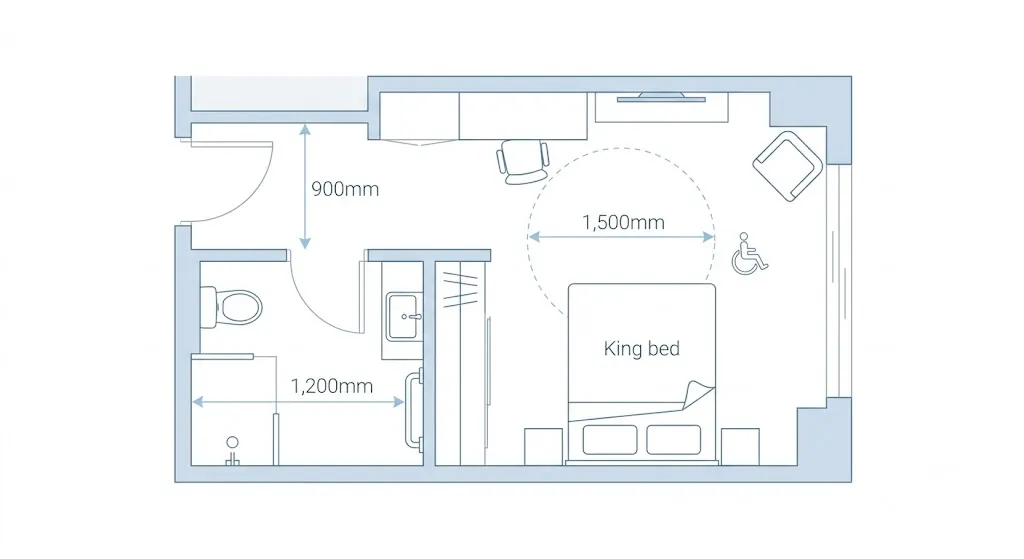
| Bedroom manoeuvring space | 1,200 mm clear, 1,500 mm turning diameter |
| Door clear width | 900 mm minimum |
| Bathroom split | 50% roll-in showers, 50% bathtubs, across accessible rooms |
| Fire alarm | Visual and acoustic, mandatory in every accessible room |
Abu Dhabi International Building Code (ADIBC)
Abu Dhabi runs on a different code: the Abu Dhabi International Building Code, based on a modified version of the American ICC/ANSI A117.1 standard, adopted in October 2013. Door clear widths here are 815 mm minimum, with 915 mm recommended as best practice. Grab bar and alarm requirements come from the AADC SSCP Annexes, Section 7.1.
Wosool: the Certificate That Makes It Real
A code is only as strong as its enforcement. In Dubai, that enforcement is Wosool, a Dubai Municipality inspection and certification programme. Engineers from the Dubai Building Permits Department check doorway widths, elevators, and bathroom facilities against the UDC, then issue a graded score:
- 75% or higher: “Accessible Building” certificate.
- 90% or higher: “Accessible UNI” certificate.
This is stamped onto the building’s completion certificate. For a new hotel, that means failing Wosool can hold up the permit needed to open. It is one of the clearest signs that UAE accessibility rules are enforced at the building-permit level, not left to a complaints process after the fact.
UAE vs ADA: Where Dubai and Abu Dhabi Set a Higher Bar
Quick answer: In several measurable areas, mainly the percentage of rooms required to be accessible and the roll-in shower mandate, Dubai’s Universal Design Code requires more than the US ADA standard does. In other areas, like turning space, the two are almost identical.
Most people assume “ADA-compliant” is the global gold standard and everything else is a lesser copy. The numbers do not support that assumption once you compare them directly.
| Element | Dubai (UAE) | Abu Dhabi (UAE) | ADA (United States) |
|---|---|---|---|
| Accessible room quota | 10% of all rooms, plus all common areas | Set by hotel classification manual (under active revision) | Roughly 1 room per 25, decreasing as room count grows (example: a 275-room hotel needs 10 accessible rooms) |
| Door clear width | 900 mm | 815 mm (915 mm recommended) | 813 mm (32 in) |
| Turning diameter | 1,500 mm | Aligned to modified ICC/ANSI A117.1 | 1,524 mm (60 in), essentially the same |
| Roll-in shower | Required in 50% of accessible rooms, at any hotel size | Per ADIBC / ICC A117.1 | Only mandatory once a hotel passes 51 rooms |
| Fire alarm | Visual + acoustic, mandatory in every accessible room | Visual + acoustic, mandatory (AADC SSCP 7.1) | Required, but notification devices are often provisioned on request rather than built into every unit |
| Compliance certificate | Wosool, graded 75%/90%, tied to completion permit | Governed by DCT hotel classification review | No national certification; enforced via complaints and litigation |
| Public recognition | DAMJ Award, standing government award | Same, DAMJ is Abu Dhabi-wide | No equivalent national award for hotel accessibility |
Two of these are worth sitting with for a second. First, Dubai’s 10% quota is a flat requirement regardless of hotel size, while the ADA’s ratio actually shrinks as a hotel gets bigger. Second, the UAE requires a roll-in shower option in half of accessible rooms no matter how small the property is, while the US only triggers that requirement once a hotel is already fairly large. On both of these specific, checkable points, Dubai’s rule is the stricter one.
Where the codes are close to identical is turning space: 1,500 mm and 60 inches are functionally the same clearance, which tells you both systems arrived at the same physical answer for how much room a wheelchair actually needs to turn around.
Note on sourcing: the ADA ratio example above reflects one documented case (a 275-room property) rather than the complete sliding-scale table in the ADA Standards. If you are relying on this for a specific project, check ADA Standards Section 224.2 directly for your exact room count.
The Route Starts Before the Room: Entrances, Corridors, and Doors
Quick answer: Accessibility does not start at the guestroom door. It starts at the accessible parking bay, continues through a step-free entrance, and runs through corridors wide enough for a wheelchair to pass and turn.
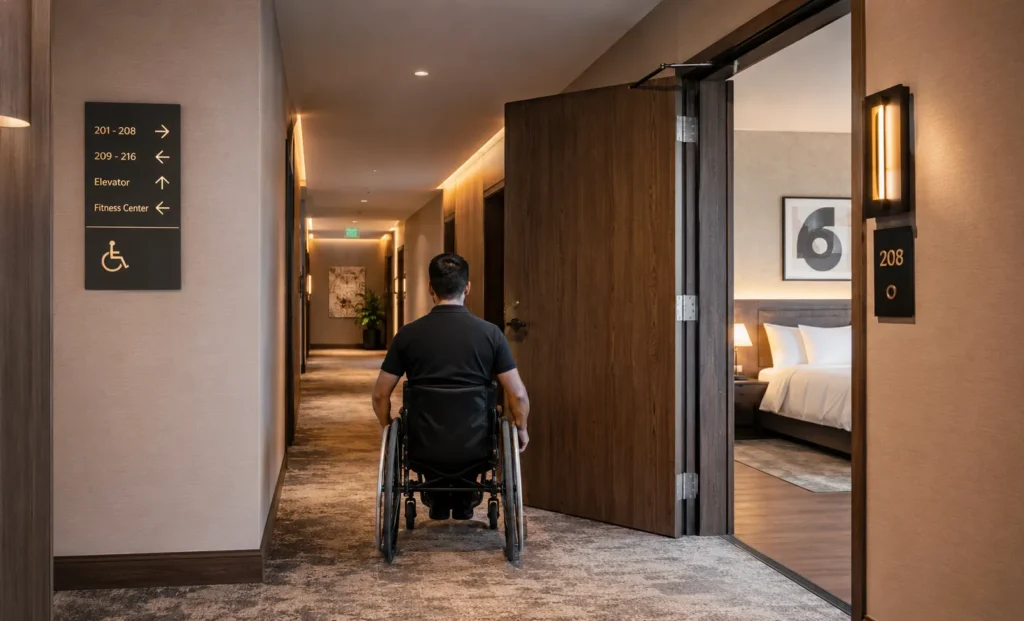
A hotel can have a flawless guestroom and still be unusable if the path to reach it is not built correctly. Under Dubai’s UDC:
- Corridors: minimum 1,000 mm wide, widening to 1,500 mm at any turn or junction.
- Guestroom door: minimum 900 mm clear width in Dubai, 815 mm in Abu Dhabi. This is the “clear opening,” meaning the usable gap when the door is fully open at 90 degrees, not the size of the door panel itself. A 900 mm door panel on standard hinges typically only delivers around 815 to 830 mm of real clear opening, which is the single most common measurement mistake we see on site. We cover this distinction in detail in our guide to wheelchair door size in the UAE.
- Thresholds: maximum 15 mm height, bevelled or ramped, with a colour-contrast strip so low-vision guests can see the level change.
- A second peephole: mounted at wheelchair-user eye height, alongside the standard one.
- Door hardware: lever handles, not round knobs, mounted 900 to 1,200 mm from the floor.
Accessible parking near the entrance matters just as much as the door itself. For a full breakdown of what compliant parking and entrance automation looks like, see our doors and parking access page. If the room sits above a step or level change at the entrance, the correct wheelchair ramp slope in the UAE is what determines whether that door is actually reachable.
Inside the Room: Bedroom Layout, Clearances, and Controls
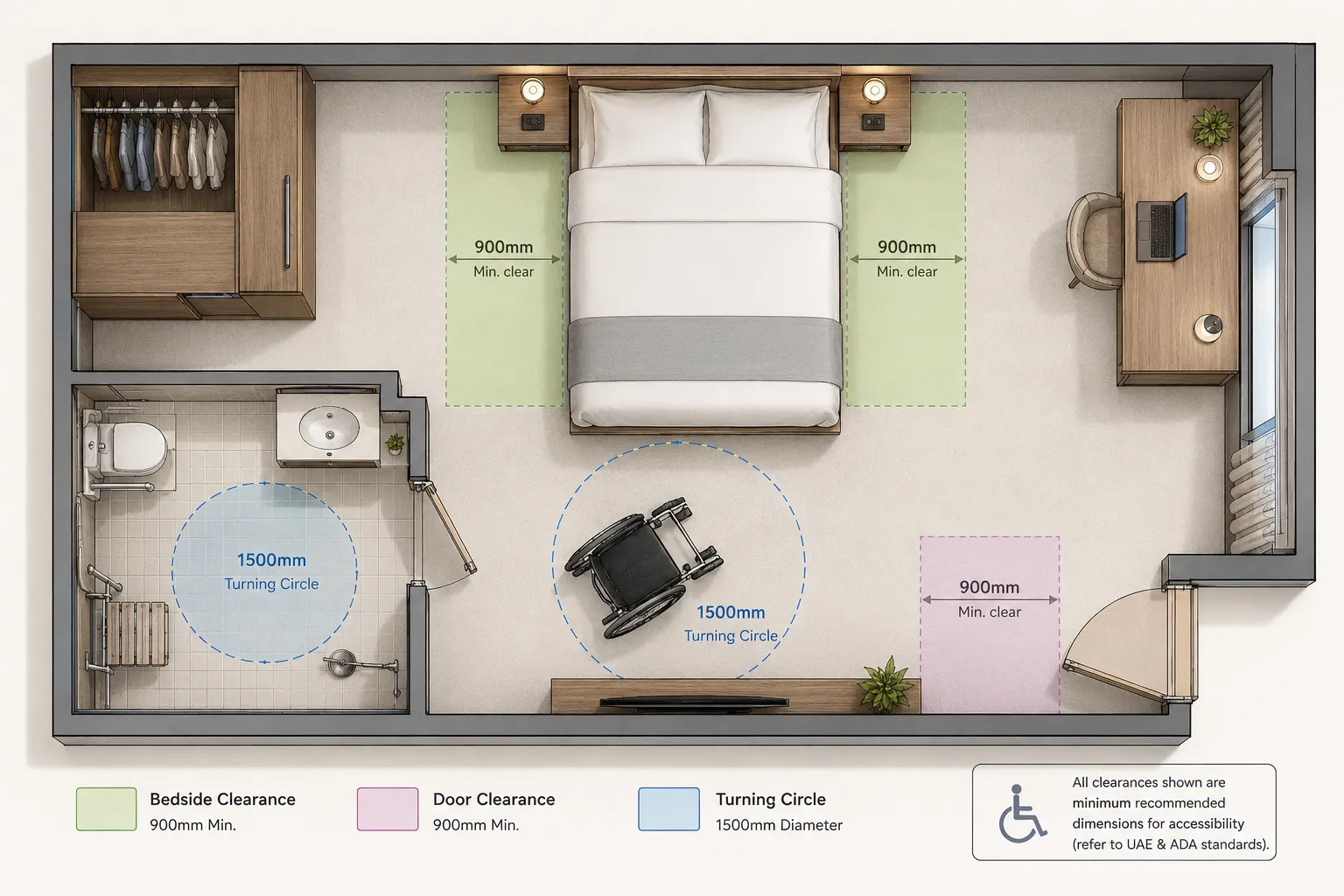
Quick answer: A compliant bedroom gives a wheelchair user 1,200 mm of clear floor space and a 1,500 mm turning circle, with the bed positioned so both sides are usable, not just one.
This is the part of the room that gets photographed for booking sites and the part that is easiest to get almost right while still missing the point. A bed pushed against one wall technically has “clear space” on the open side, but if the guest needs to transfer from the other side, the room fails in practice even though it passes on the drawing.
What the room needs:
- 1,200 mm clear manoeuvring space and a 1,500 mm turning diameter: kept genuinely clear, not partially blocked by furniture or a luggage rack.
- Clearance on both sides of the bed: not just one, since transfer direction depends on the guest’s own mobility, not the room designer’s assumption.
- Wardrobe rails and shelving: at 1,100 to 1,200 mm height, reachable from a seated position.
- Controls: for air conditioning, lighting, curtains, and any smart panel, installed at 900 to 1,200 mm, at least 600 mm clear of any internal corner.
- A desk or table with knee clearance: so a wheelchair user can actually pull up to it rather than work from an angle.
- A visual and acoustic in-room fire alarm: covered in full in the fire safety section below.
Flooring choice affects usability as much as layout. Hard, non-slip, low-pile surfaces are what allow smooth wheelchair movement without the drag and resistance of thick carpet; our guide to accessible flooring standards in the UAE covers exactly what’s required. If the room includes smart controls for lighting, curtains, or the alarm system, our smart home and access control integration explains how that gets wired into an accessible layout properly.
The Accessible Bathroom: Roll-In Showers, Grab Bars, and Alarms
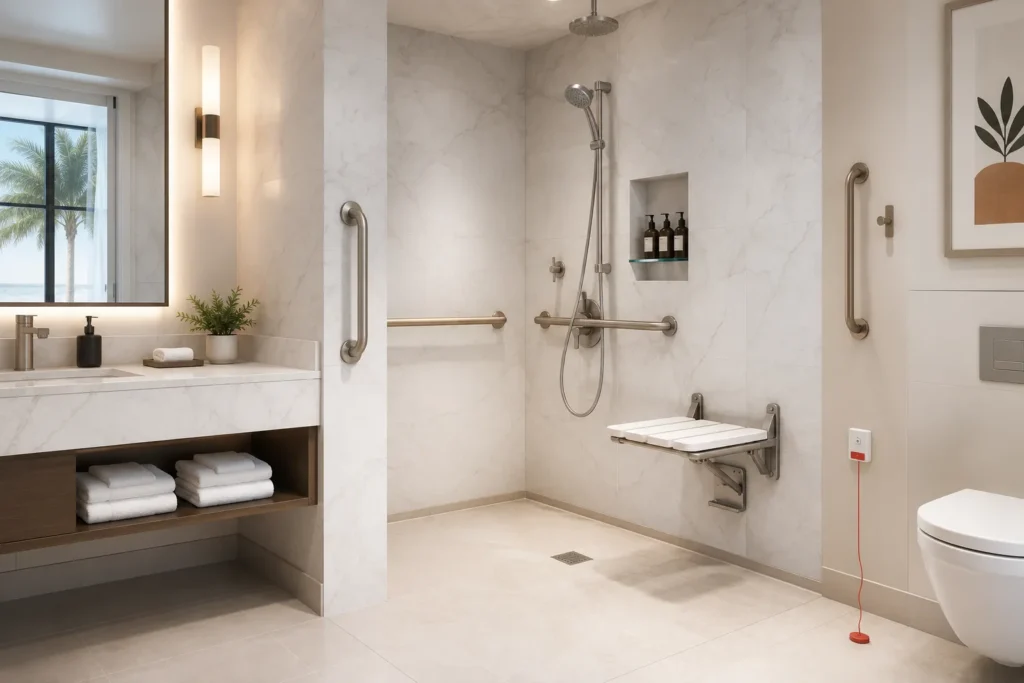
Quick answer: A compliant hotel bathroom needs a wide, outward-opening or sliding door, a turning circle of at least 152.5 cm, grab bars at 840 to 915 mm, and either a roll-in shower or an accessible bathtub, with an alarm pull-cord that reaches floor level.
The hotel guestroom bathroom is where the general UAE accessible-toilet rules meet a hotel-specific requirement: Dubai’s code requires that half of all accessible rooms have roll-in showers and half have bathtubs, both built to code, both with an alarm. That split exists because different guests need different things: a guest who can transfer independently may prefer a seated bath, while a guest who cannot transfer at all needs a roll-in shower with no lip to cross.
| Element | Standard |
|---|---|
| Door swing | Outward or sliding only, never inward |
| Turning circle | 152.5 cm minimum, kept fully clear |
| Grab bar height | 840 to 915 mm, load-rated to roughly 113 kg (250 lbs) |
| Roll-in shower | Requires a dedicated transfer space beside it, per Dubai UDC |
| Alarm system | Pull-cord reaching near floor level, both visual and audio signal at the panel outside |
| Toilet seat height | 43 to 48 cm |
That alarm cord detail matters more in a hotel than almost anywhere else. A guest travelling alone has no one else in the room if they fall. If the cord has been tied up out of the way by housekeeping (which we see more often than you would expect), a mandatory safety feature becomes a piece of decoration.
For the complete bathroom checklist, including toilet paper dispenser positioning, changing tables, and the full 14-point compliance list, see our detailed guide to handicap toilet compliance in the UAE. Grab bar and handrail hardware options are covered on our handrail and grab bar systems page.
Fire Safety and Emergency Evacuation for Guests with Disabilities
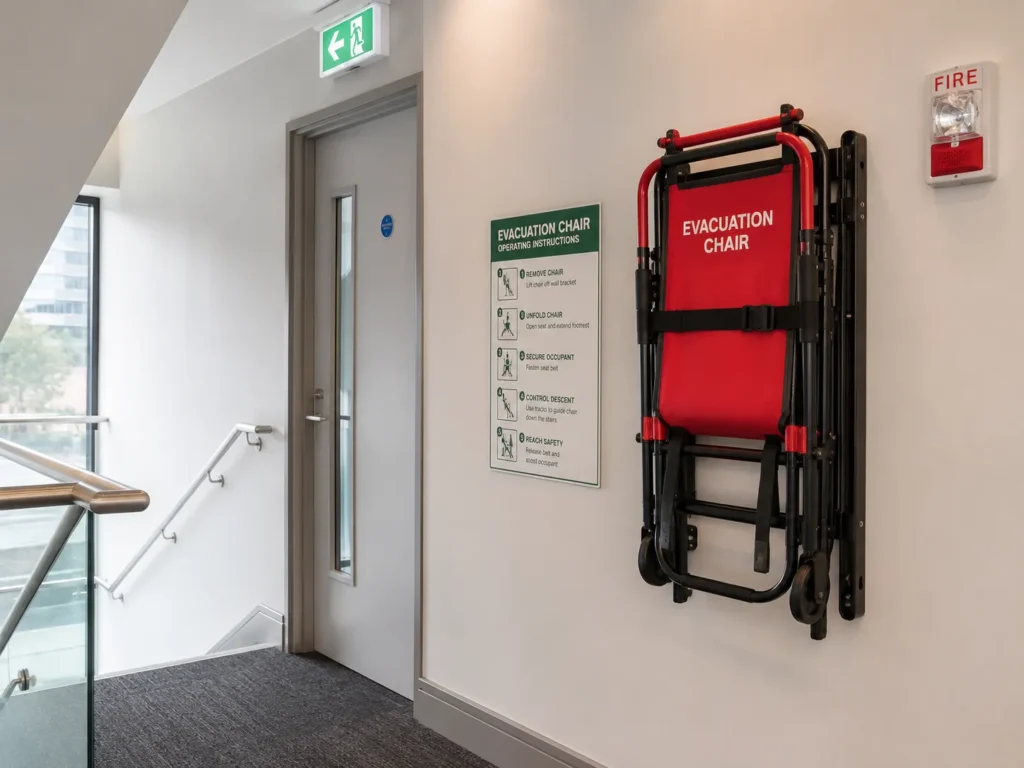
Quick answer: UAE code requires every accessible hotel room to have both a visual (strobe light) and an audible fire alarm, and hotels above two storeys should have an evacuation chair positioned at every staircase on every floor, especially where accessible rooms are located.
This is the subtopic most “best accessible hotels” travel articles skip entirely, and it’s arguably the most important one. A guest who cannot hear a standard alarm, or cannot use a stairwell during an evacuation, needs two things a general fire safety plan does not automatically provide:
- A visual alarm (a strobe light) alongside the audible one, mandated for every accessible room under both the Dubai UDC and AADC SSCP Annexes, Section 7.1.
- An evacuation chair, a wheeled device that lets a person descend a staircase in their own chair, or with assistance, when lifts are shut down during a fire event. Best practice is one chair per staircase per floor in buildings over two storeys, with extra units on any floor holding accessible guestrooms.
Multi-level resorts and villa-style properties, where lift redundancy cannot always be guaranteed during an emergency, need this more than a typical city-centre tower. If your property has multiple floors connected by stairs rather than lifts alone, our guide to accessible stair design in the UAE covers the handrail, nosing, and tactile warning requirements that apply during normal use and during an evacuation.
Beyond the Guestroom: Common Areas, Pools, and the Full Guest Journey
Quick answer: Dubai’s code requires every common area of a hotel, not just the guestrooms, to be accessible, including the lobby, restaurants, gym, spa, and pool.
This is where UAE hospitality genuinely pulls ahead of a code-minimum, guestroom-only mindset. An accessible room means very little if the guest cannot reach the pool, order at the restaurant, or use the gym independently. Under the Dubai UDC, all common spaces in a hotel fall under the same accessibility requirement as the guestrooms themselves.
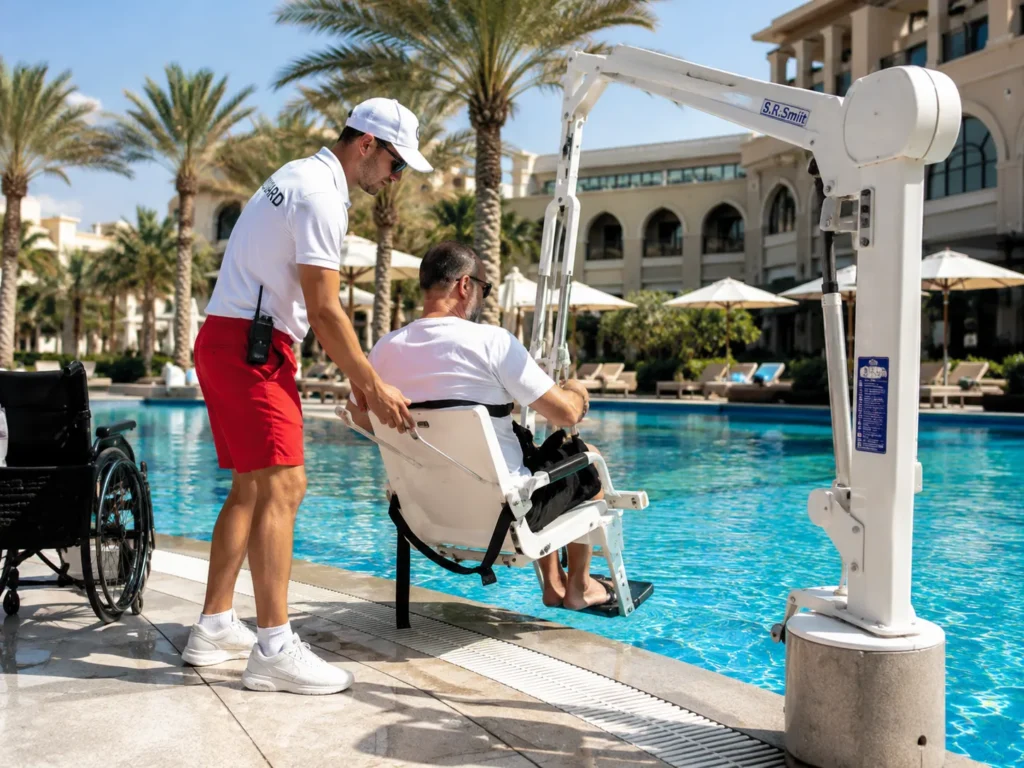
The clearest example of this in practice is pool and beach access. A growing number of 4- and 5-star UAE resorts now install:
- Pool lifts and pool hoists, allowing a wheelchair user to enter and exit the water independently or with minimal assistance. See our pool lift and pool hoist systems page for the range of equipment used across UAE hotels.
- Beach access matting: firm portable pathways laid over sand so a wheelchair or mobility scooter can reach the shoreline.
- Accessible loungers, shaded seating at wheelchair height, and step-free changing facilities.
For a broader view of the equipment used to complete an accessible route through a hotel, from lifts to guidance systems, our inclusive mobility solutions page covers the full range.
The DAMJ Award: How UAE Hospitality Gets Recognised for Accessibility
Quick answer: The DAMJ Award is Abu Dhabi’s government recognition programme for organisations, including hotels, that excel at accessibility and inclusion. Nothing quite like it exists under the ADA framework in the US.
ADA compliance in the US is a legal floor: meet it or risk a complaint and a lawsuit. The UAE has that same enforcement layer through Wosool and the building code system, but it also has something the US does not: a standing, government-run award that publicly recognises hotels and businesses for going further than the minimum.
The DAMJ Award’s Accessibility evaluates exactly the areas this guide covers: entrances, corridors, washrooms, parking, signage, and emergency systems. “Hotels & Hospitality” is named as one of the specific sectors the award targets. A hotel that wins DAMJ recognition is not just avoiding liability, it is demonstrating, publicly, that its accessibility work is ahead of the code floor.
For the full breakdown of eligibility, categories, and how to prepare an application, see our complete guide to the DAMJ Award.
Where Hotels Get It Wrong: Field Notes from UAE Compliance Reviews
Quick answer: The most common accessibility failures in UAE hotels are not missing features, they are features installed slightly wrong: a grab bar a few centimetres off height, a turning circle blocked by furniture, or an alarm cord that has been tied out of reach.
In every property I review, the room usually has all the required elements on the architect’s drawing and on the compliance certificate. The failures show up when you actually put a wheelchair in the room. The patterns repeat across almost every project:
- Grab bars installed 50 to 80 mm off the correct height: close enough to look right in a photo, far enough to be genuinely difficult or unsafe to use.
- A turning circle that measures correctly on paper but is encroached in the finished room by a pedal bin, a luggage rack, or stored cleaning equipment.
- Inward-swinging bathroom doors: a straightforward code violation, and also a rescue-access risk: if a guest collapses against the inside of the door, staff cannot get in.
- Alarm pull-cords tied up or shortened by housekeeping staff, because a hanging cord is seen as untidy. The system is physically present and completely non-functional.
- A grab bar with no wall blocking behind it: so it looks solid but fails under real load.
The single recurring lesson across every one of these: passing a visual inspection is not the same as being usable by the person the room was built for. If you are responsible for a hotel’s accessible rooms, the only way to know for certain is to test the room from a wheelchair before sign-off, not after a guest complaint.
Accessible Hotels in Dubai and Abu Dhabi: What Good Looks Like
Quick answer: Several UAE resorts are frequently cited for strong accessibility, including properties on Palm Jumeirah, Downtown Dubai hotels near Burj Khalifa, and resorts in Sharjah with trained accessibility staff, though features can change and should always be confirmed directly before booking.
To ground this locally rather than in the abstract, some frequently cited examples from independent accessible-travel reviewers include:
- A Palm Jumeirah resort: rated highly by accessible-travel reviewers for a king bed with wheelchair space on both sides, extra-wide doorways and hallways, and a barrier-free roll-in shower with an attached shower chair.
- Downtown Dubai hotels: near Burj Khalifa and Dubai Mall, cited for accessible city-centre options within a short distance of major attractions.
- ECOS Hotel and Coral Beach Resort Sharjah, named by Gulf News among top hotel destinations for People of Determination in the UAE, with Coral Beach staff trained in basic sign language and access to online interpreters.
A necessary caveat: hotel amenities and accessible-room inventory change over time. Before booking or publishing a recommendation, confirm current features directly with the property, ideally by phone, describing your exact mobility needs rather than relying on the “accessible” filter on a booking site alone.

Frequently Asked Questions
What are accessible hotel rooms?
Accessible hotel rooms are guestrooms built to specific code requirements, wider doors, clear turning space, grab bars, and reachable controls, so that wheelchair users, ambulatory disabled guests, and elderly travelers can use them independently. They are legally defined, not just larger standard rooms.
What is the difference between a wheelchair accessible hotel room and a handicap accessible hotel room?
Nothing. They describe the same room. “Wheelchair accessible” and “accessible” are the current preferred terms; “handicap accessible” is an older term still widely used in search and everyday conversation but not the institutional language used in UAE code documents.
Are there handicap accessible hotel rooms in Dubai?
Yes. Under the Dubai Universal Design Code, hotels are legally required to make at least 10% of their total rooms accessible, along with every common area (lobby, restaurants, pool, gym). Compliance is inspected and certified through Dubai Municipality’s Wosool programme.
Why are accessible hotel rooms cheaper?
Accessible rooms are often priced lower on booking sites mainly because of lower demand, not lower quality. Fewer guests search specifically for these rooms, so hotels sometimes discount them to keep occupancy up, particularly on OTA platforms with high price competition. It is not a sign the room is worse; in many hotels, the accessible room’s bathroom is actually larger than a standard room’s.
Can normal people book accessible hotel rooms?
Yes, technically anyone can book an accessible room, and many hotels will assign one to a non-disabled guest if it’s the last room available. However, hotels are generally expected to hold accessible rooms for guests who need the features until all comparable standard rooms are sold, and it’s considered poor etiquette to book one you don’t need if other options exist, since the supply of genuinely accessible rooms is already limited.
Can I put 3 people in a 2-person hotel room?
This depends on the hotel’s occupancy policy and local fire code limits, not on whether the room is accessible or standard. Most hotels allow a third guest in a 2-person room but charge an extra person fee, and it’s important to disclose extra guests at booking or check-in rather than arriving unannounced. In an accessible room specifically, adding a rollaway bed can eat into the mandatory turning space and clear floor area, which is a genuine safety issue, so always confirm with the hotel before adding a bed to an accessible room rather than a standard one.
What is the minimum percentage of accessible rooms a UAE hotel must provide?
In Dubai, it’s 10% of total rooms under the Universal Design Code, plus all common areas. Abu Dhabi’s requirement is set through its hotel classification manual, which is currently under revision; a specific fixed percentage was not confirmed in current published sources at the time of writing.
Do UAE accessible hotel rooms have roll-in showers?
Half of all accessible hotel rooms in Dubai must have roll-in showers, and the other half must have accessible bathtubs, both to code specification. This applies regardless of hotel size, unlike the US ADA standard, which only requires roll-in showers once a hotel has more than 51 rooms.
Is Wosool certification the same as ADA compliance?
No. Wosool is Dubai’s own inspection and certification system, administered by Dubai Municipality, and it produces a graded percentage score (75%+ or 90%+) tied to a building’s completion permit. ADA compliance in the US has no equivalent grading or certificate; it’s a legal standard enforced mainly through complaints and litigation after the fact.
The Bottom Line
An accessible hotel room in Dubai or Abu Dhabi is not a smaller, cheaper version of a real hotel room, and it is not a lesser standard than what American travelers expect from ADA. On several specific, checkable measures, the UAE’s requirements go further: a flat 10% room quota regardless of hotel size, a mandatory roll-in shower option in every property, and a graded certification system tied directly to a building’s legal right to open.
What separates a genuinely accessible room from one that only looks accessible on paper comes down to details most guests never think to check: the exact height of a grab bar, whether a turning circle is actually kept clear, whether the alarm cord still reaches the floor. If you’re a hotel owner, architect, or facility manager preparing for a Wosool inspection or a DAMJ Award application, get in touch with Flex Access for a compliance review before an inspector or a guest finds the gap first.
Regulatory References
- Federal Law No. 29 of 2006 Concerning the Rights of People of Determination
- Dubai Universal Design Code, Dubai Municipality, Sections 5.19, 5.19.1, 5.19.2
- Abu Dhabi International Building Code, Sections 604 and 609
- AADC SSCP Annexes, Section 7.1
- Dubai Municipality, Wosool certification announcement
- U.S. Access Board, ADA Chapter 6, Bathing Rooms
- ADA Standards Section 224.2, Transient Lodging Guest Rooms
- Gulf News, Top hotel destinations for People of Determination in the UAE
- Flex Access: Handicap Toilet in the UAE, Wheelchair Door Size in the UAE, Wheelchair Ramp Slope in the UAE, Accessible Stairs in the UAE, Accessible Flooring in the UAE, The DAMJ Award