Quick answer: Accessibility remediation for an existing hotel in Dubai means finding where the building falls short of Part C of the Dubai Building Code, fixing those gaps in order of risk, and keeping the fixes working. Most of the work can be phased so the hotel stays open. Wosool certification is the target, but hotels should confirm eligibility with Dubai Municipality first.
Many hotels in Dubai opened before the 2017 Dubai Universal Design Code, and many more before its building rules moved into Part C of the Dubai Building Code in 2021. These properties now operate under a legal duty to maintain accessibility, in buildings that were never designed for it.
This guide is for hotel owners, general managers, directors of engineering and asset managers. It covers what to fix, in what order, and how to do it without closing the hotel. For what Wosool is and how the score works, read our Wosool guide. For the dimensions an accessible guestroom must meet, read our accessible hotel rooms guide.
What accessibility remediation means for an existing hotel
Remediation is the work of bringing an operating building up to the accessibility standard it should meet. In a new hotel, accessibility is designed in and checked before the completion certificate. In an existing hotel, you work inside a fixed structure, with guests in the building and revenue at stake.
In my site reviews, hotel gaps come from three places:
- The building predates the rules: Stepped entrances, split-level lobbies and sunken lounges were common design choices before the universal design code.
- Renovations removed features: A refurbished restaurant gains a raised platform, or a new reception desk loses its lowered section.
- Operations wore them down: Accessible entrances get locked for security, alarm cords get tied up, and furniture fills turning spaces.
The legal position matters too. Under Dubai Law No. 3 of 2022 and its bylaw, owners of existing buildings must maintain accessibility, and violations carry fines of up to AED 100,000 (Law No. 3 of 2022). Remediation is how a hotel meets that duty.
Can a hotel get Wosool certification?
Possibly, but check with Dubai Municipality before you plan around it. Dubai Municipality’s published list of who can apply for the existing building evaluation covers schools and nurseries, shopping centres, and government and semi-government bodies (service card). Hotels are not on it.
That list has not stopped every other venue type. VOX Cinemas at Mall of the Emirates, a cinema, received the certificate in July 2026 (Majid Al Futtaim). A Wosool team engineer also said in October 2026 that the team visits private buildings (Al Bayan).
My advice to hotels is to remediate to Part C either way. The legal duty to maintain accessibility applies whether or not you hold a certificate, and the work is the same. If Dubai Municipality accepts your application, you are ready. If it does not, your building still meets the standard Wosool scores against.
The score levels, the two-stage visit and the application steps are covered in our Wosool guide.
Owner or operator: who leads remediation?
The owner should lead, with the operator closely involved. In Dubai, many hotels are owned by one company and run by another under a management agreement, and accessibility work sits across both.
| Role | Usually responsible for |
|---|---|
| Owner | Building works, capital spending, permits, attending any Dubai Municipality site visit through a representative |
| Operator | Brand accessibility standards, staff training, housekeeping and maintenance routines, guest communication |
| Both | Agreeing the gap list, the order of works and which areas close when |
Dubai Municipality requires the owner’s representative at a Wosool site visit (service card), which is another reason the owner should hold the process. International brands often have their own accessibility standards on top of local code, so the operator’s brand team should see the gap list early. Your management agreement decides who pays for what, so check it before works are scoped.
Step 1: Find the gaps
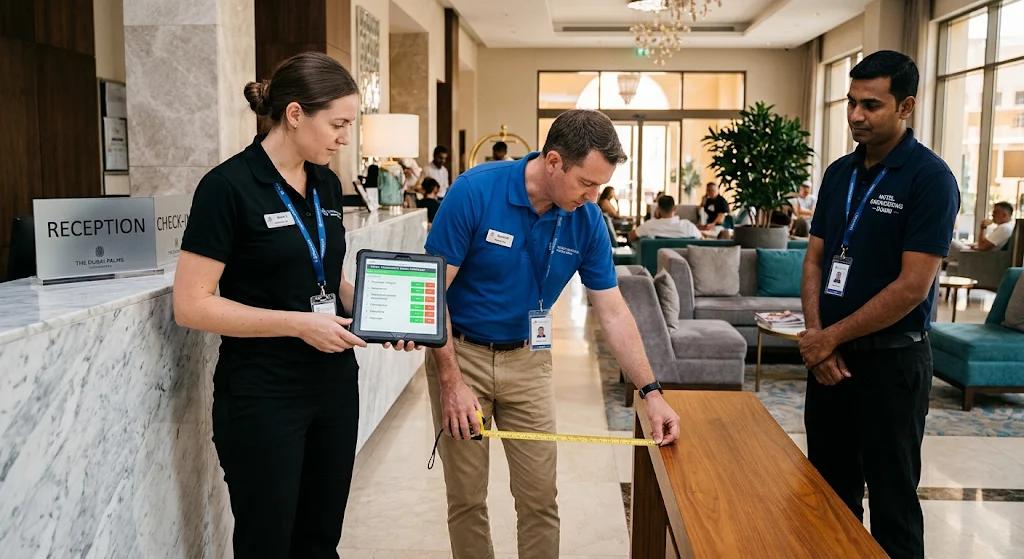
You cannot prioritise what you have not measured. There are three ways to get a gap list, and they can be combined.
- An independent audit: An accessibility consultant walks the hotel against Part C and gives you a prioritised written report. This works whether or not your hotel is eligible for Wosool.
- A Dubai Municipality initial assessment: If Dubai Municipality accepts your application, the optional initial assessment is free and shows you their own view of the gaps, with mandatory items highlighted.
- An internal walk-through: Your engineering team does a first pass. Useful for spotting obvious gaps, but it tends to miss what only shows up from a wheelchair.
Whichever route you take, walk the hotel the way a guest moves through it, in this order:
- Arrival: drop-off, valet, parking and the route to the door
- Main entrance and lobby
- Reception, concierge and lifts
- Corridors and guestrooms
- Restaurants, bars and terraces
- Pool, beach, spa and gym
- Ballrooms, meeting rooms and business centre
- Public toilets throughout
- Signage and wayfinding between all of the above
- Emergency exits and evacuation routes
Test every accessible feature you already have during the walk. A platform lift that does not run, or an automatic door switched to manual, counts as a gap.
Step 2: Prioritise what to fix first
Fix life safety first, then the main guest route, then everything else. A long gap list is normal for an older hotel, and trying to fix it all at once usually means nothing gets finished.
| Priority | What it covers | Why it comes here |
|---|---|---|
| 1. Life safety | Visual fire alarms, working toilet alarms, evacuation chairs and procedures | A guest who cannot hear an alarm or use the stairs is at risk today |
| 2. Mandatory items | Anything flagged as mandatory in a Dubai Municipality report | Dubai Municipality highlights these separately, and they carry weight in the score |
| 3. The main route | Parking to entrance, entrance to reception, reception to lifts and rooms | If a guest cannot reach the room, nothing else matters |
| 4. Core facilities | Main restaurant, pool, public toilets | Facilities every guest is expected to use |
| 5. Secondary areas | Spa, gym, meeting rooms, secondary outlets | Important, but they can follow once the core route works |
Within each tier, separate two kinds of fix. Equipment fixes, such as portable ramps, evacuation chairs or toilet alarms, usually need no structural work. Building works, such as new ramps, lifts or rebuilt bathrooms, need design and usually a permit. Start the building works’ design early, and use equipment fixes to close what you can in the meantime.
Step 3: Remediation by hotel area
Each area below lists the gaps I see most often in older Dubai hotels and the usual ways to close them. The right fix depends on the building, so treat these as options to assess on site, not a shopping list.
Arrival, porte-cochère and parking
Typical gaps: accessible bays placed far from the entrance, a kerb between the drop-off and the door, valet areas with no step-free route.
Fix options: relocate accessible bays next to the main entrance, add dropped kerbs or a short ramp at the drop-off, and mark a clear route from the bays to the door. See our doors and parking solutions.
Main entrance and lobby
Typical gaps: a grand stepped entrance with the accessible door round the side, heavy manual doors, revolving doors with no alternative, a reception counter with no lowered section.
Fix options: make the main entrance step-free where the structure allows, rather than sending guests to a side door. Add automatic pedestrian doors beside revolving doors. Add a lowered section to the reception and concierge desks.
Level changes in public areas
Typical gaps: split-level lobbies, sunken lounges, raised bar areas and stages reached only by steps. This is the most common gap I see in hotels built before the code.
Fix options: where there is room, a permanent ramp built to the correct ramp slope. Where there is not, a wheelchair platform lift or stair lift usually fits within the existing footprint. For short level changes, a custom ramp kit avoids rebuilding the floor.
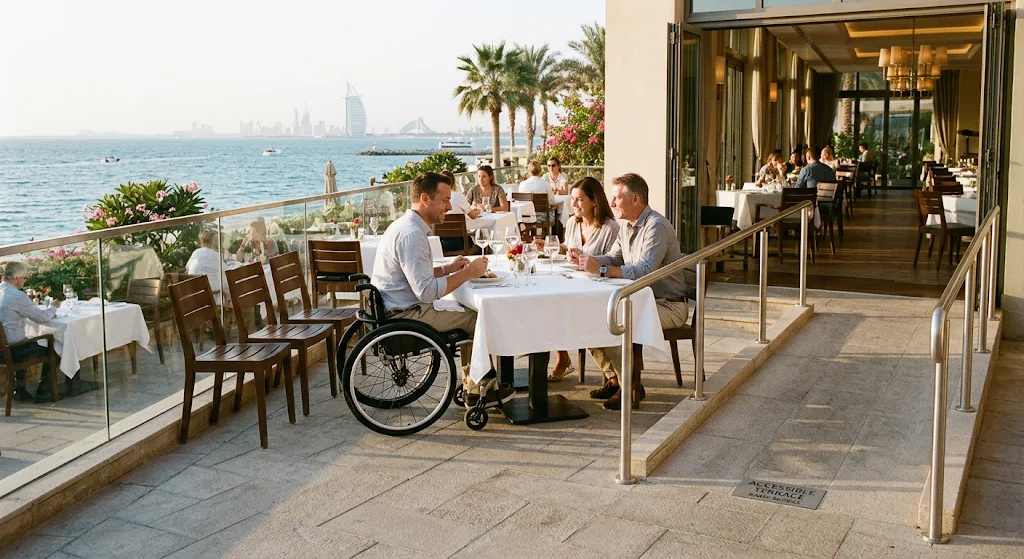
Restaurants, bars and terraces
Typical gaps: terraces one step above the dining room, buffet counters too high to reach from a seat, fixed booth seating with no wheelchair space, outlets on mezzanines with no lift.
Fix options: level or ramp terrace thresholds, keep a section of each buffet within seated reach, and plan loose tables in every outlet that a wheelchair can pull up to. Staff can serve from a high counter, but the guest should not have to ask to get in.
Pool deck and beach
Typical gaps: no way into the pool except steps or a ladder, loungers on sand with no firm path, changing rooms with a step at the door.
Fix options: a pool lift or pool hoist for each main pool, beach access matting from the hotel to the shoreline, and at least one step-free changing and shower room. For resorts, pool and beach access is often what an accessible guest chooses the hotel for.
Spa, gym, ballrooms and meeting rooms
Typical gaps: spa treatment rooms down a stair, gym equipment packed too close for a wheelchair, ballroom stages with steps only, meeting rooms on a level the lifts do not serve.
Fix options: move at least one treatment room to an accessible level, space out a section of the gym, and provide a ramp or platform lift to every stage. Event spaces are where hotels earn corporate and government business, and those clients increasingly ask about access.
Converting existing rooms into accessible rooms
Typical gaps: too few accessible rooms, or rooms labelled accessible that fail on site. Our accessible hotel rooms guide lists the features and dimensions a room must meet.
Fix options: when converting rooms, choose ones close to the lifts and to an evacuation route, on floors with step-free access to the hotel’s facilities. Spread them across room categories so an accessible guest is not limited to the cheapest room type. Bathroom conversion is usually the largest part of the work; see our accessible bathroom service.
Wayfinding, tactile guidance and signage
Typical gaps: low-contrast or decorative signage, no Braille on key signs, no warning surfaces at the top of stairs, room numbers too small to read.
Fix options: high-contrast signs at readable heights with Braille on key ones, and tactile walking surface indicators at stairs, ramps and hazards. Hotels often resist tactiles for looks; stainless steel tactile studs suit marble and stone lobbies better than plastic tiles.
Evacuation
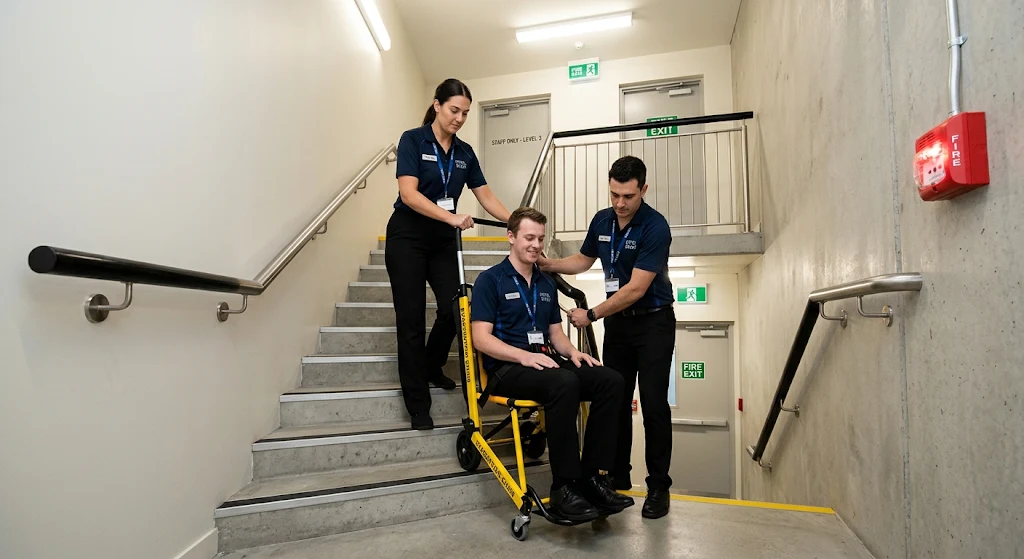
Typical gaps: no plan for guests who cannot use the stairs, no visual alarms in accessible rooms, evacuation chairs bought but never used in a drill.
Fix options: add visual alarms where missing, place evacuation chairs at stairwells, and train night staff to use them. Front desk should know which rooms hold guests who may need help, so the plan works at 3am, not only on paper.
Remediating while the hotel stays open
Most hotel remediation can be done without closing the property, if the works are planned by zone rather than by trade.
- Work zone by zone: Finish one area completely, from the gap list to a tested fix, before opening the next. A half-finished lobby is worse for guests than an untouched one.
- Use quieter periods: Schedule noisy or disruptive works for the hotel’s low season and low-occupancy days. Back-of-house routes and closed outlets can be done at any time.
- Keep an accessible route open at all times: If works block the accessible entrance or a lift, provide a temporary alternative first. A portable wheelchair ramp can hold a route open while a permanent one is built.
- Take guestrooms out in small groups: Convert accessible rooms a few at a time, away from occupied floors where possible.
- Tell guests and booking channels: Update the website, booking engine and OTA listings so an accessible guest knows what is available during works. Front desk should be briefed before every phase starts.
Which works need approval?
Building works that change the structure or layout go through Dubai Municipality’s normal permit route before they start. That typically includes new permanent ramps, passenger lifts, rebuilt bathrooms and changes to entrances. Altered parts of an existing building are expected to meet current requirements, so use every fit-out to close accessibility gaps rather than create new ones.
Equipment that does not change the building, such as portable ramps, evacuation chairs or freestanding signage, may not need a permit. Rules differ by item and by location, and hotels in free zones or special development zones may answer to their own authority as well. Confirm the approval route with Dubai Municipality or your zone authority before you buy or install anything.
An independent auditor can tell you which items on your gap list are likely to need a permit, so your engineering team can start those designs first.
Keeping it working after remediation
A hotel can pass an evaluation and fail its next accessible guest within a week. In hotels, the risk is operational: features work on the day of the visit, then housekeeping, security and maintenance routines slowly undo them.
Build these into standard operating procedures:
- Housekeeping: alarm cords hang free to the floor, turning space in accessible rooms stays clear, shower chairs and grab bars are checked at every clean.
- Security: accessible entrances stay unlocked during opening hours, and automatic doors stay on automatic.
- Maintenance: platform lifts, pool hoists, door operators and alarms are on a planned service schedule, not repaired after a complaint. Our repair and maintenance service covers accessibility equipment.
- Front desk and reservations: accessible rooms are held for guests who need them, and staff can describe each room’s features accurately when a guest calls.
- Training: staff know how to operate every piece of equipment, including evacuation chairs, and refresh that training when teams change.
Hotels have high staff turnover, so training once is not enough. Make accessibility part of onboarding.
How Flex Access helps hotels
Flex Access takes a hotel from the gap list to a building that works for every guest, with one team for the audit, the supply, the installation and the upkeep. Dubai Municipality evaluates buildings and issues the Wosool certificate; we prepare hotels for it. We do not issue, guarantee or speed up the certificate.
- Audit: we walk your hotel against Part C of the Dubai Building Code and give you a prioritised report, with life safety and mandatory items first.
- Plan: we work with your owner and operator teams to phase works around occupancy.
- Supply and install: platform lifts, stair lifts, ramps, automatic doors, accessible bathrooms, pool hoists, beach matting, tactiles, signage and evacuation chairs.
- Maintain: planned servicing so equipment works on every guest’s stay, not only on inspection day.
We have worked with teams at Rixos and Hilton, and installed the wheelchair platform lift at VOX Cinemas Yas Mall in Abu Dhabi.
Planning remediation at your hotel? Book a free assessment or message us on WhatsApp, and we will tell you what stands between your hotel and a fully accessible guest journey.
Frequently asked questions
Can a hotel in Dubai apply for Wosool?
Hotels are not on Dubai Municipality’s published list of applicants for the existing building evaluation, but other unlisted venues have been certified. Ask Dubai Municipality before you apply, and remediate to Part C of the Dubai Building Code either way.
Does an existing hotel have to be made accessible?
Yes. Under Dubai Law No. 3 of 2022 and its bylaw, owners of existing buildings must maintain accessibility. Holding a Wosool certificate is not stated as compulsory for existing buildings, but the duty to be accessible is.
Can a hotel be remediated without closing?
In most cases, yes. Phase the works zone by zone, schedule disruptive work for low-occupancy periods, and keep a temporary accessible route open while permanent works are underway.
Should we convert rooms or upgrade our existing accessible rooms?
Start by testing the rooms you already call accessible. Many fail on details that are simple to fix. Convert more rooms only once the existing ones work, choosing rooms near lifts and evacuation routes.
Who pays for accessibility works, the owner or the operator?
It depends on your management agreement. Building works and capital spending usually sit with the owner, while training and operating routines sit with the operator. Check the agreement before works are scoped.
What if our hotel is in Abu Dhabi?
Wosool applies only in Dubai. Abu Dhabi uses its own system, the Sahel accessibility rating.
Sources
- Dubai Municipality: Certificate of Compliance with Accessibility Regulations for Existing Buildings (service card)
- Dubai Municipality: Dubai Universal Design Code and Wosool Service
- Dubai Law No. 3 of 2022 on the rights of persons with disabilities
- Executive Council Resolution No. 1 of 2022, implementing bylaw
- Majid Al Futtaim: VOX Cinemas Mall of the Emirates receives Wosool, July 2026
- Al Bayan: Dubai Municipality’s Wosool team, October 2026