If you are renovating an apartment in Dubai, designing a commercial fit-out in Abu Dhabi, or adapting a home for a family member who uses a wheelchair, the door is usually the first barrier you encounter and the one most people underestimate. Getting the width wrong does not just create daily inconvenience. Under the Dubai Universal Design Code (UDC) and Abu Dhabi accessibility standards, non-compliance can block project approvals and final completion permits entirely.
This guide covers the correct wheelchair door size for UAE homes, offices, and commercial spaces, including the exact numbers from local standards, how wheelchair type affects what you need, and what your options are when existing doors fall short. If you need a professional assessment, Flex Access offers a free accessibility consultation across the UAE.
The UAE Standard for Wheelchair Door Width (And Why It Differs from What You Read Online)
Most articles on this topic default to ADA measurements in inches. The UAE operates on different standards, expressed in millimetres, governed by local codes rather than American law.
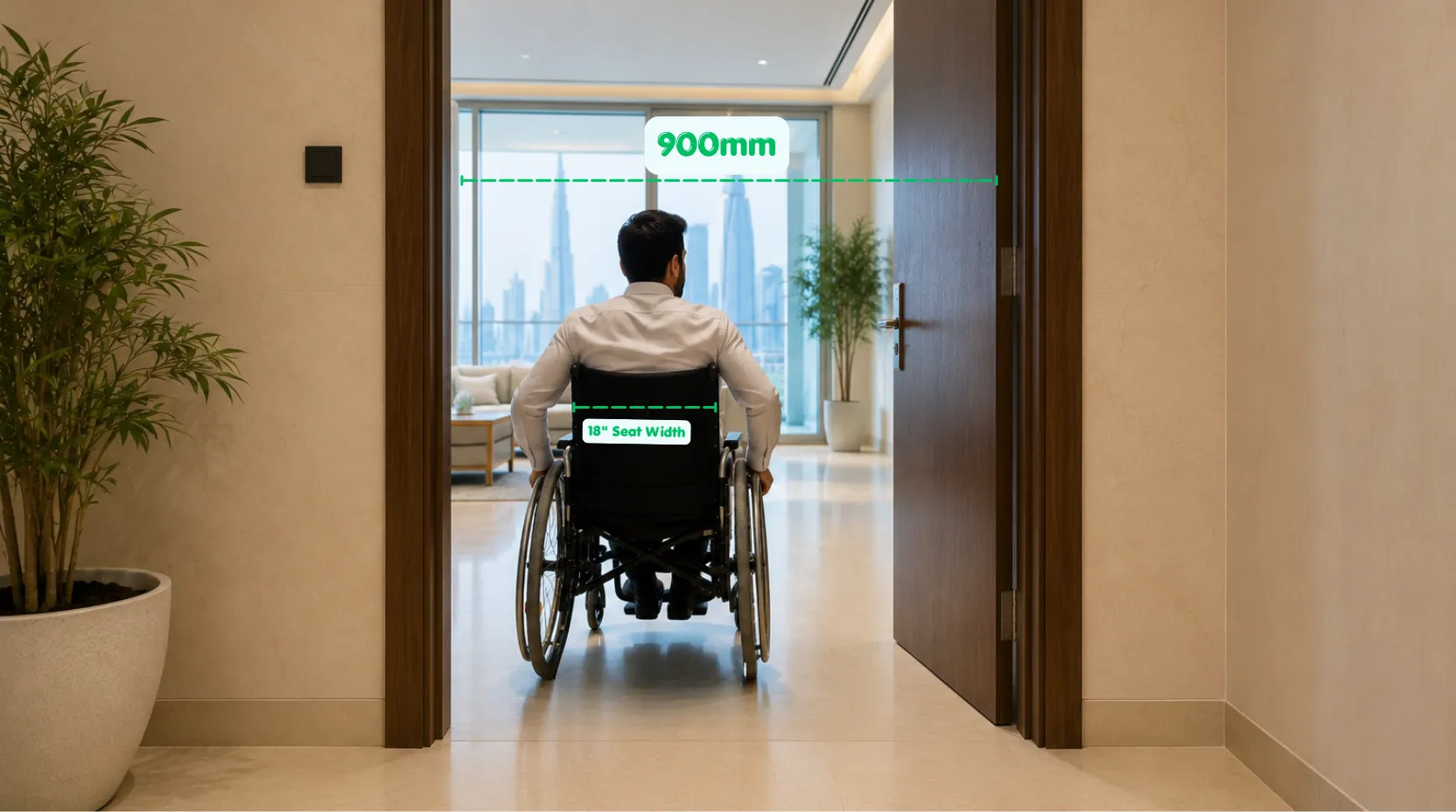
- According to the Dubai Universal Design Code (UDC), all doors on an accessible route must provide a minimum clear passage width of 900mm. Internal corridors connected to those doors must be at least 1,000mm wide, widening to 1,500mm at directional changes to allow a wheelchair user to turn safely.
- The Dubai Health Authority Health Facility Guidelines go further for clinical settings: rooms requiring wheelchair or mobility aid access must have a minimum clear door opening of 900mm, while rooms needing hoist or shower trolley access require 1,000mm minimum. [REF: DHA Health Facility Guidelines, Part C Section 6]
- In Abu Dhabi, the accessibility standard aligned with ICC A117.1 requires a minimum clear door opening of 815mm, with a best-practice recommendation of 915mm for doorways more than 610mm deep.
- For marine and ferry environments, the Dubai Universal Design Code specifies a minimum doorway width of 850mm.
| Building Type | Minimum Clear Door Width (UAE) |
|---|---|
| Residential and commercial (Dubai UDC) | 900mm |
| Healthcare facilities (DHA guidelines) | 900mm min / 1,000mm for hoists |
| Marine / ferry doors (Dubai UDC) | 850mm |
| Abu Dhabi accessibility standard | 815mm (best practice: 915mm) |
Important: “Clear width” means the opening available when the door is fully open at 90 degrees, measured from the face of the door to the opposite stop. A 900mm door on standard hinges typically provides only 815 to 830mm of actual clear opening depending on door thickness. Always confirm the net clear opening with your contractor, not the door panel width.
Does UAE Law Actually Require Wheelchair-Accessible Doors in Your Building?
This is the question Nouh Aqra hears most often during site assessments, and the answer carries a misconception that costs businesses time and money. The most common assumption: if a building passed a Dubai Municipality inspection, all its doors are accessible. That is not correct.
General building inspections check fire safety, structural compliance, and MEP systems. The Dubai UDC applies specifically to new buildings and publicly accessible areas. Private apartment unit interiors are largely exempt unless the unit is designated as an accessible dwelling.
For businesses, the critical compliance mechanism is the Wosool certification issued by Dubai Municipality. According to the Dubai Universal Design Code, Wosool inspectors evaluate doorway widths, turning spaces, corridor clearances, and bathroom facilities as part of the final completion permit process. Businesses that fail Wosool cannot receive that permit. Hotels face additional requirements: 900mm clear doors throughout accessible guestrooms, a 1,500mm turning diameter in both the bedroom and bathroom, and lateral transfer space at the toilet. [REF: Dubai UDC, Wosool certification requirements]
The lesson from the field: do not assume a passed inspection equals accessibility compliance. Get a proper gap assessment before your Wosool submission, not after a failed one.
A related area that often surfaces during the same assessment is accessible bathroom provision. If you are reviewing door widths, it is worth simultaneously checking whether your handicap toilet facilities meet UAE standards, as both are evaluated together in a Wosool inspection.
How Your Wheelchair Type Changes the Door Width You Actually Need
The 900mm standard accommodates the majority of wheelchair types in common use, but not all. The average manual wheelchair measures between 610mm and 685mm overall width (wheel to wheel). Wheelchair widths can range from as narrow as 533mm for transport chairs to over 1,015mm for heavy-duty bariatric models. The gap between chair width and door width determines whether independent navigation is realistic.
- Manual wheelchairs (standard): 610 to 685mm overall width. A 900mm door provides 215 to 290mm of clearance on either side, enough for a straight approach.
- Transport wheelchairs: 560 to 585mm wide. Designed to be pushed by a caregiver, they can navigate openings as narrow as 810mm.
- Power / electric wheelchairs: 610 to 815mm wide. A 900mm door is workable for most models, but heavy-duty power chairs at the upper end benefit from a 1,000mm opening.
- Bariatric wheelchairs: Up to 1,015mm wide. Standard accessible doors will not accommodate these. Custom widening to 1,100mm or more is required.
- Mobility scooters: 510 to 760mm wide. Generally clear accessible doors but may struggle with tight turns due to their turning radius.
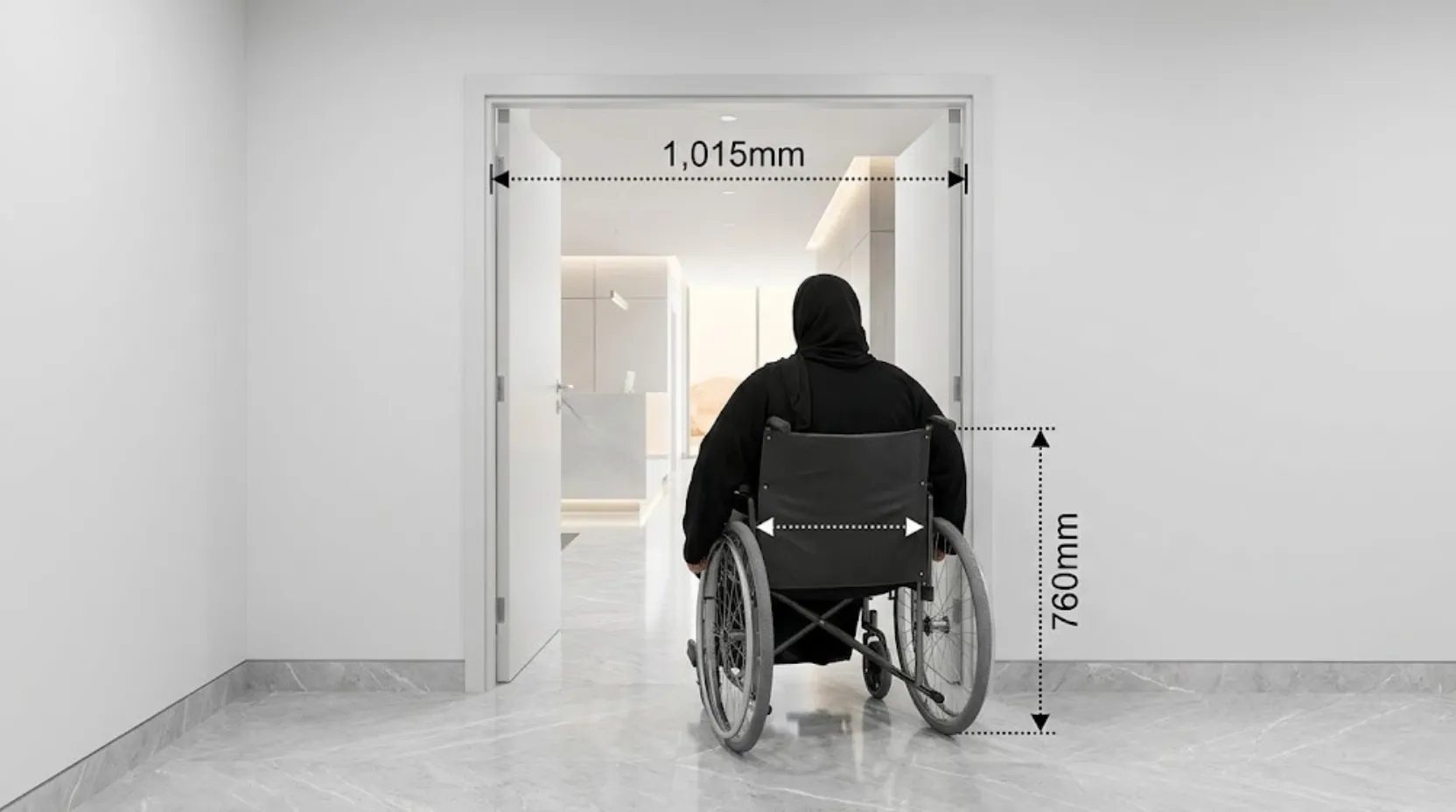
The most common buying mistake is comparing a doorway’s clear opening against the wheelchair’s seat width listed on the product page rather than the overall width including wheels, hand rims, and frame. Always measure the overall width of the specific chair before assuming any doorway will work.
It Is Not Just the Width (What Else Around the Door Affects Wheelchair Access)
A correctly sized door is necessary but not sufficient. According to the Dubai Universal Design Code, several factors surrounding the door itself determine whether a wheelchair user can navigate it independently.
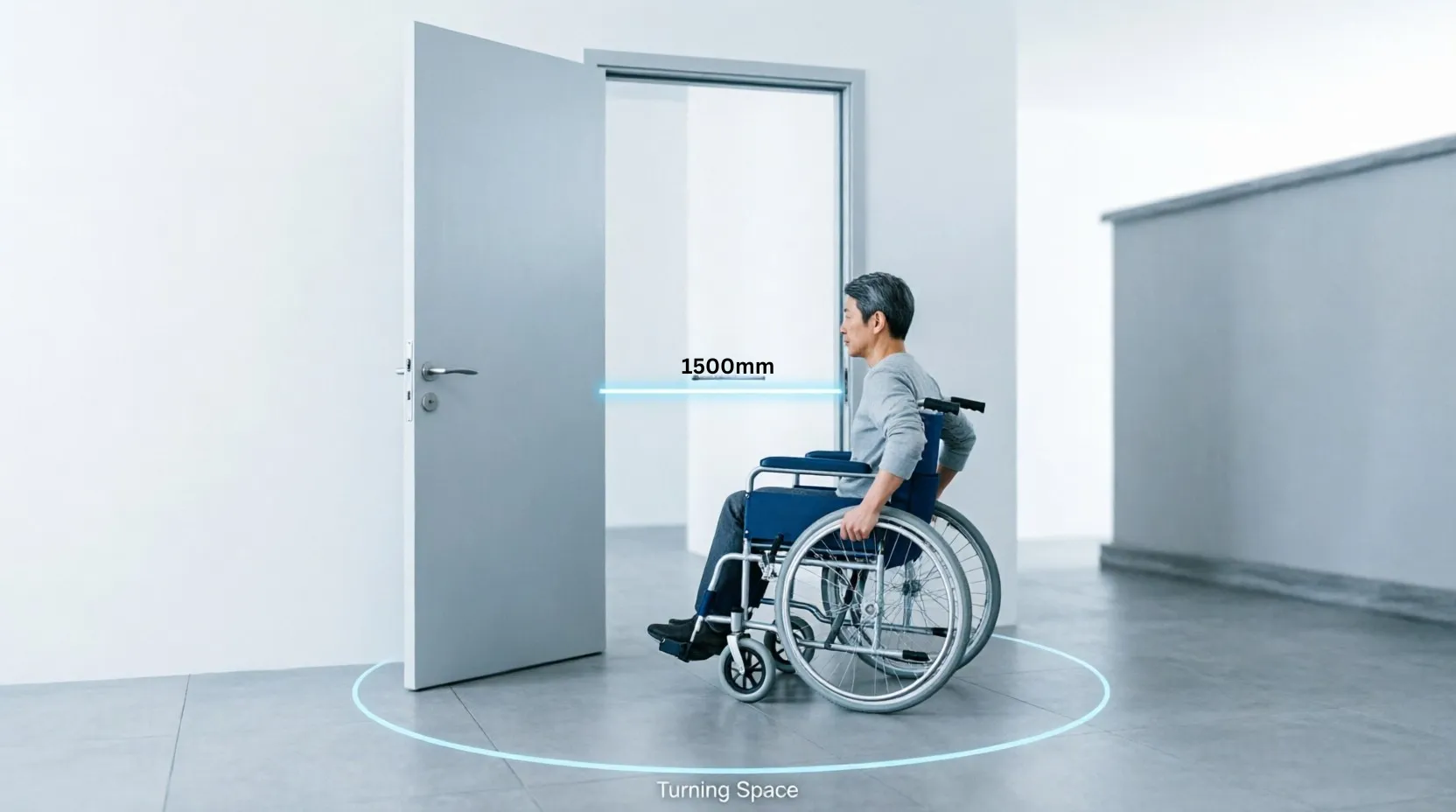
- Manoeuvrability space: The Dubai UDC requires a 1,500mm x 1,500mm obstacle-free zone at the door. Without this, even a 900mm door becomes difficult to approach and open independently.
- Door handles and hardware: Must be operable with the elbow. Lever handles at 900 to 1,200mm from the floor. Horizontal door handle bars should measure 300mm in length at 900 to 1,000mm height.
- Thresholds: Maximum 15mm height, bevelled or ramped, with a colour-contrasting strip of at least 50 LRV points.
- Door swing direction: Inward-opening bathroom doors can block space if a user falls inside. The DHA guidelines recommend outward-opening capability for rooms used without staff assistance. (DHA Health Facility Guidelines)
- Sliding and pocket doors: Eliminate the swing arc entirely. Dubai UDC permits top-track sliding doors. Floor tracks are not recommended as they collect dust and create cleaning difficulties. (DHA Health Facility Guidelines)
- Automatic door openers: Standard in UAE hospitals and malls, increasingly available for residential and office installation for fully independent access.
Access to upper floors and split-level spaces presents a related challenge. If your building or villa has level changes that cannot be addressed through ramping alone, a stairlift may be the most practical solution to maintain accessibility between floors without structural renovation.
What to Do When Your Existing Doors Are Too Narrow
If your doors fall below the required clear width, there are several options ranging from low-cost adjustments to structural modifications. Offset hinges and door removal are the least invasive starting points, while structural widening is the appropriate route when full compliance is required.
- Offset / swing-clear hinges: Add approximately 25mm of clear width without structural work. A practical temporary measure for private homes, but does not achieve UDC compliance on its own. Estimated cost: AED 200 to 600 per door.
- Removing the door: Immediate clearance gain for non-private spaces. Replace with a curtain or room divider where privacy is needed. No structural cost.
- Non-load-bearing wall widening: The most common modification to reach 900mm or 1,000mm clear opening. Involves removing the frame, modifying the wall opening, installing a new frame, and refinishing surfaces. Estimated cost in UAE: AED 2,000 to 6,000 per door.
- Pocket or sliding door conversion: Eliminates swing space permanently. Dubai UDC permits top-track sliding doors where fire egress requirements are met. (DHA Health Facility Guidelines) Estimated cost in UAE: AED 3,000 to 8,000 per door.
- Structural widening: Required when a load-bearing wall is involved. Needs a structural engineer and Dubai Municipality building permit. Appropriate for full UDC compliance projects.
For spaces where a step or level change exists near the door, the door width modification needs to be considered alongside ramp provision. Understanding the correct wheelchair ramp slope is equally important, as an incorrectly graded ramp can make an accessible door effectively unreachable. The Dubai UDC specifies ramp gradients of no steeper than 1:20 for wheelchair access.
What Flex Access Checks in a Free Accessibility Consultation and Why It Is Different
Most people who contact an accessibility provider expect to be told their door is X mm wide and they need Y. What Nouh Aqra and the Flex Access team do is different: the free consultation assesses the full access journey, not just the door in isolation.
Here is specifically what a Flex Access consultation covers that a standard contractor measurement does not:
- Clear opening vs panel width: Most contractors quote panel width. 32-inch / 815mm minimum refers to clear opening, not door panel size. Flex Access measures and reports the actual clear opening at every door on the access route.
- Manoeuvrability space at each door: Can the user actually position, open, and pass through independently? A door meeting 900mm but with a wall immediately adjacent to the handle side may still be unusable.
- Threshold and hardware compliance: Checked against Dubai UDC specifications, not generic accessibility guidelines.
- Turning circle verification: Bathroom and corridor turning space confirmed against the 1,500mm diameter requirement from the Dubai UDC. (Dubai UDC)
- Wheelchair type matching: Nouh checks whether the client’s specific chair will navigate the space, not whether a theoretical standard wheelchair fits.
- Wosool compliance gap report: For businesses, a prioritised list of what needs to change before inspection, with exact specifications a contractor can act on.
- Written specification summary: A document the client takes directly to their contractor with precise measurements and compliance references, eliminating miscommunication at the build stage.
Flex Access has also supported clients applying for the Damj Award, Dubai’s recognition programme for organisations demonstrating outstanding commitment to inclusion and accessibility. A Wosool-compliant space is a strong foundation for that application, and the consultation process covers the relevant criteria.
Summary: Getting Wheelchair Door Size Right in the UAE
Three things every reader should take from this guide:
- The UAE standard is 900mm minimum clear width under the Dubai Universal Design Code, not the ADA’s 32 inches. Clear width is not the same as door panel width.
- The door itself is only one part of the access equation. Manoeuvrability space, hardware, thresholds, and turning circles all determine whether a wheelchair user can move independently.
- Whether you are adapting a home or preparing a commercial space for Wosool inspection, a professional assessment gives you a specific, actionable plan, not a general number to hand to a contractor.
If you are unsure whether your space meets UAE accessibility requirements, Flex Access offers a free accessibility consultation across the UAE. Nouh Aqra will assess your specific space, measure clear openings, check the full access route, and give you a written report you can act on. There is no obligation and no guesswork.
Book your free consultation at flexaccess.ae.
Frequently Asked Questions
What is the minimum door width for wheelchair access in the UAE?
The minimum clear door width under the Dubai Universal Design Code is 900mm. This applies to all doors on an accessible route in residential, commercial, and hospitality buildings. In Abu Dhabi, the minimum is 815mm with a best-practice recommendation of 915mm.
Note that “clear width” refers to the actual opening when the door is fully open at 90 degrees, not the door panel size. A 900mm panel on standard hinges typically delivers only 815 to 830mm of usable clear opening, so always confirm the net clear opening with your contractor.
Can a wheelchair fit through a 28-inch door?
Most standard manual wheelchairs measure between 610mm and 685mm (24 to 27 inches) overall width. A standard wheelchair may technically fit through a 28-inch door, but clearance is tight. Thicker door frames, handles, or an angled entry can reduce usable space further. In the UAE context, a 28-inch (711mm) opening falls well below the 900mm Dubai UDC requirement and is not considered accessible.
For a private home, a narrow transport wheelchair may pass through, but independent navigation will be difficult and daily use is not practical.
What is the difference between door panel width and clear opening width?
Door panel width is the size of the door leaf itself. Clear opening width is the actual usable space when the door is fully open at 90 degrees, measured from the face of the door to the opposite stop. This 32-inch or 815mm measurement refers to the clear opening width, not the door itself. A 900mm door panel on standard hinges typically delivers around 815 to 830mm of clear opening.
To achieve a true 900mm clear opening, you generally need a panel of around 940 to 950mm. Always ask your contractor or door supplier for the net clear opening figure, not the panel size.
Is an 800mm door wide enough for a wheelchair in Dubai?
An 800mm door falls below the 900mm minimum set by the Dubai Universal Design Code and is not compliant for new or renovated accessible spaces. Some narrow transport wheelchairs measuring around 560 to 585mm may physically pass through an 800mm opening, but this does not meet UAE standards. While 32 inches (815mm) meets the minimum code, 36 inches (915mm) is the real-world recommendation for comfortable navigation.
If you are modifying a private home rather than a commercial space, an 800mm clear opening is a workable interim option for narrow chairs, but 900mm should be the target.
Does a wheelchair door in the UAE need special handles or hardware?
Yes. The Dubai Universal Design Code specifies that door hardware on accessible routes must be operable without tight gripping or twisting. Lever handles are required in place of round knobs. Hardware must be installed between 900mm and 1,200mm from the floor. Horizontal grab bars at doors should be 300mm in length at a height of 900 to 1,000mm.
Thresholds must not exceed 15mm in height and should be bevelled or ramped with a colour-contrasting strip. These hardware requirements are assessed as part of the Wosool certification inspection alongside door width.
What wheelchair door width is needed for a bathroom in the UAE?
For accessible bathrooms in the UAE, the Dubai UDC requires a minimum 900mm clear door opening. Where a hoist or shower trolley is used, the DHA Health Facility Guidelines require a 1,000mm minimum. Inside the bathroom, the UDC requires a 1,500mm turning diameter to allow a wheelchair user to reposition independently. A door that meets 900mm but opens inward into a tight bathroom can still create a problem. Outward-opening or sliding doors are strongly preferred for bathroom applications.
Do UAE apartments legally require wheelchair-accessible doors?
The Dubai Universal Design Code applies to new buildings and publicly accessible areas. Private apartment interiors are largely exempt unless the unit is specifically designated as an accessible dwelling. However, any business or building pursuing Wosool certification from Dubai Municipality must meet the 900mm door width requirement across all assessed areas. Standard residential interior doors measure between 24 and 30 inches wide, so most will need to be widened to meet accessibility requirements if the space is subject to a compliance inspection.
What is the recommended door width for a power wheelchair in UAE homes?
Power wheelchairs are typically 30 to 34 inches (762 to 864mm) wide due to their extra hardware. The Dubai UDC’s 900mm minimum clear opening accommodates most standard power chairs, but heavy-duty models at the wider end of the range will benefit from a 1,000mm clear opening. If you are purchasing a power wheelchair for use in a UAE home or apartment, measure every doorway’s clear opening before buying and compare it against the chair’s overall width, not the seat width listed in the product specification.
What does a Flex Access free accessibility consultation check for doors?
A Flex Access consultation goes beyond a single tape measure reading. Nouh Aqra checks the actual clear opening at every door on the access route, the manoeuvrability space on both sides of the door, hardware and threshold compliance against Dubai UDC specifications, turning circle space inside bathrooms and corridors, and whether the client’s specific wheelchair type will navigate each door independently. For commercial clients, the consultation produces a Wosool compliance gap report with exact specifications a contractor can act on. The consultation is free with no obligation.
Sources