
Tactile Paving in UAE
Flex Access supplies and installs tactile paving across Dubai, Abu Dhabi and the rest of the UAE: warning studs, guiding strips, tactile tiles and plates, planned together with Braille signage and tactile maps. As a UAE accessibility specialist, we check every route against the code of your emirate before anything is ordered.
Quick Answer
What is tactile paving?
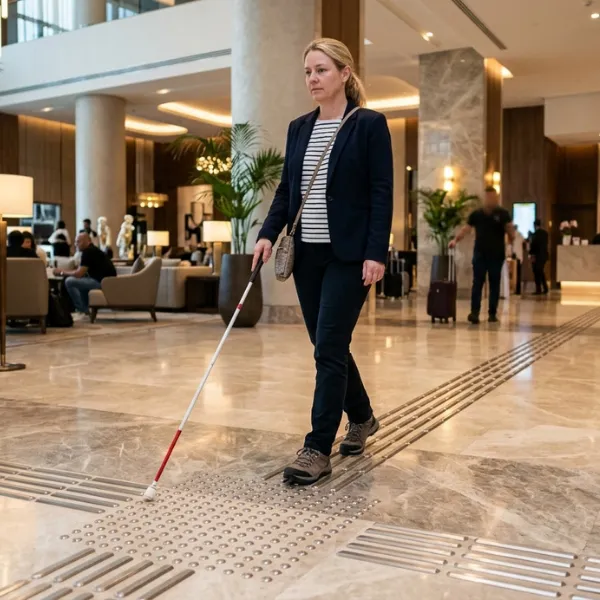
Tactile paving is a textured, colour-contrasted walking surface that people who are blind or have low vision can feel with a cane or their feet. Raised domes warn them to stop before a hazard, and raised bars guide them along a safe route. In technical specifications it is also called tactile ground surface indicators (TGSI) or detectable warning surfaces. In the UAE, tactile paving must follow the building code of each emirate, such as the Dubai Universal Design Code, which limits the texture height to 4mm and asks for at least 50 LRV points of contrast with the surrounding floor.
Our Range
Tactile paving available in the UAE
Every route is built from a few core products. Choose the one that fits your floor, or let us choose for you at a free consultation.
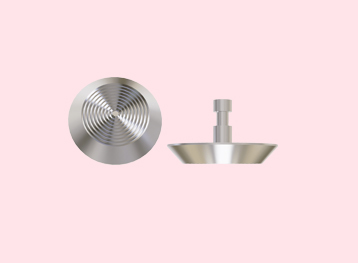
Tactile Studs
Individual stainless steel warning studs, fixed into your existing floor at stairs, ramps, lifts and crossings.
View Tactile Studs →
Tactile Strips
Steel and paving strips that build a guiding route across lobbies, plazas and sidewalks.
View Tactile Strips →
Tactile Tiles and Plates
Porcelain, stainless steel and PU units with the pattern built in, for new floors or fixed on top of old ones.
View Tiles and Plates →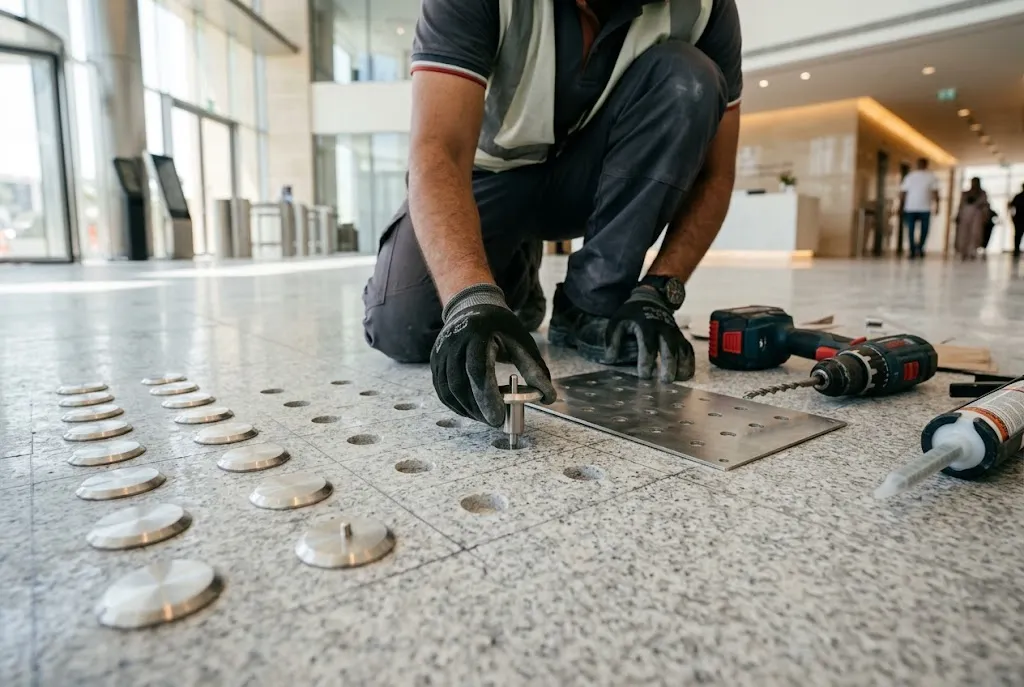
Tactile Installation
Site audit, route planning to code, installation and handover documents, all by one team.
View Installation →Not sure which tactile paving you need?
Tell us about your building. We will recommend the right products for your floor, your route and your emirate's code.
Types
Types of tactile paving
UAE building codes use two types of tactile paving. Most buildings need both, working together as one route.

Warning tactile paving (domes)
Rows of raised domes, laid across the path just before a hazard. They mean "stop and check". Used at stairs, ramps, lifts, escalators, road crossings and platform edges.
Made with tactile warning studs or dome tiles →
Directional tactile paving (bars)
Raised bars that run in the direction of travel. They mean "follow this path". Used across open areas, such as lobbies and plazas, where there is no wall or kerb to follow.
Made with tactile strips or directional tiles →The six types of tactile paving you may hear about
UK guidance lists six types of tactile paving by where they are used. The UAE codes group these into the two types above. Here is how they match up.
| UK type | Where it is used | UAE equivalent |
|---|---|---|
| Blister | Pedestrian road crossings | Warning (domes) |
| Corduroy | Tops and bottoms of stairs and hazards | Warning (domes) under the Dubai code |
| Platform edge (on-street) | Tram and bus platforms | Warning (domes) |
| Platform edge (off-street) | Rail and metro platforms | Warning (domes) |
| Segregated cycle track | Shared paths for bikes and people | Not commonly used in UAE buildings |
| Guidance path | Routes across open spaces | Directional (bars) |
How It Works
How blind and low-vision people use tactile paving
Find the route
The cane picks up the raised bars near an entrance, car park or bus stop.
Follow the bars
The person sweeps the cane across the bars and walks along them.
Stop at the domes
A band of domes warns of a turn, a stair, a lift or a road ahead.
Reach the destination
The route ends at a door, lift or counter, where Braille signs confirm the place.
People with some sight also use the colour. That is why tactile paving must stand out clearly from the floor around it.
Choosing
Which tactile paving is right for your project?
| Your situation | Best choice | Why |
|---|---|---|
| Existing marble, granite or porcelain floor | Tactile studs and tactile strips | Fixed into the floor one by one, no re-tiling, discreet look |
| New building or re-tiling | Porcelain tactile tiles | Laid as part of the floor, flush and long-lasting |
| Building that must stay open | Self-adhesive studs, strips or PU plates | No drilling, fitted quickly, little disruption |
| Outdoor walkways and sidewalks | Porcelain tiles, SS316 steel or screw-fixed PU | Handle UAE heat, sun and sand |
| Pool decks and wet areas | SS316 plates or studs with anti-slip inserts | Extra grip when wet, no corrosion |
| Carpeted areas | Screw-fix carpet studs and strips | Stay firm on soft flooring |
Where It Is Needed
Tactile paving by building type
Every public building in the UAE needs tactile paving at its hazards and along its main routes. What changes is where the route goes.
Government service centres
From the entrance to the queue, counters and exits.
Malls and retail
Entrances, escalators, lifts and car park links.
Hospitals and clinics
Reception, lifts, wards and patient-facing doors.
Metro, rail and bus
Platform edges, ticket areas and station exits.
Hotels
Lobby, lifts, restaurants and pool areas.
Schools and universities
Gates, stairs, corridors and shared spaces.
Sidewalks and car parks
Crossings, drop-off points and building approaches.
Villas and residential
Entrance steps and outdoor stairs for a family member with low vision.
Materials
Tactile paving materials at a glance
| Material | Look | Best for | Available as |
|---|---|---|---|
| Stainless steel (SS316 or SS304) | Premium, metallic | Busy public buildings, outdoor and coastal sites (SS316) | Studs, strips, plates |
| Porcelain | Matches the paving | New floors and outdoor walkways | Tiles |
| PU (polyurethane) | Bright, practical | Quick retrofits and buildings that stay open | Plates and strips |
| Brass and PVD colours | Warm, decorative | Hotels and premium lobbies | Studs, strips, plates |
UAE Requirements
Tactile paving requirements in the UAE
The UAE has no single tactile rulebook. Each emirate follows its own building code, under the federal law on the rights of People of Determination. We work to the code that applies where your building is.
Maximum texture height under the Dubai Universal Design Code
Minimum contrast between the tactile paving and the floor around it
Depth of a warning band, starting at least 300mm from the hazard
| Emirate | Code | In short |
|---|---|---|
| Dubai | Dubai Universal Design Code, Section 5.3 | Warning domes and directional bars, 4mm maximum height, 50 LRV contrast |
| Abu Dhabi | Abu Dhabi International Building Code 2013, with Abu Dhabi/ICC A117.1 | Warning surfaces required at open transit platform edges (Section 1109.9), details under A117.1 |
| Sharjah and Northern Emirates | UAE Universal Design Code | Federal tactile surfaces requirements |
| All emirates | Federal Law No. 29 of 2006 | The right of People of Determination to safe, independent access |
For the detailed rules on each product, see our tactile studs, tactile strips and tactile tiles and plates pages, or our tactile installation service.
Complete Wayfinding
One planned route: tactile paving, Braille signage and tactile maps
Tactile paving tells a person where to walk. Signage tells them where they are. We plan all four parts together, so they lead to the same places.
Warning surfaces
Domes at every stair, ramp, lift and crossing.
Guiding routes
Bars from the entrance to every key destination.
Braille and tactile signs
At doors, lifts, toilets and decision points, at the height the code sets.
Tactile maps
A raised map at the entrance, so visitors can understand the building before they set off.
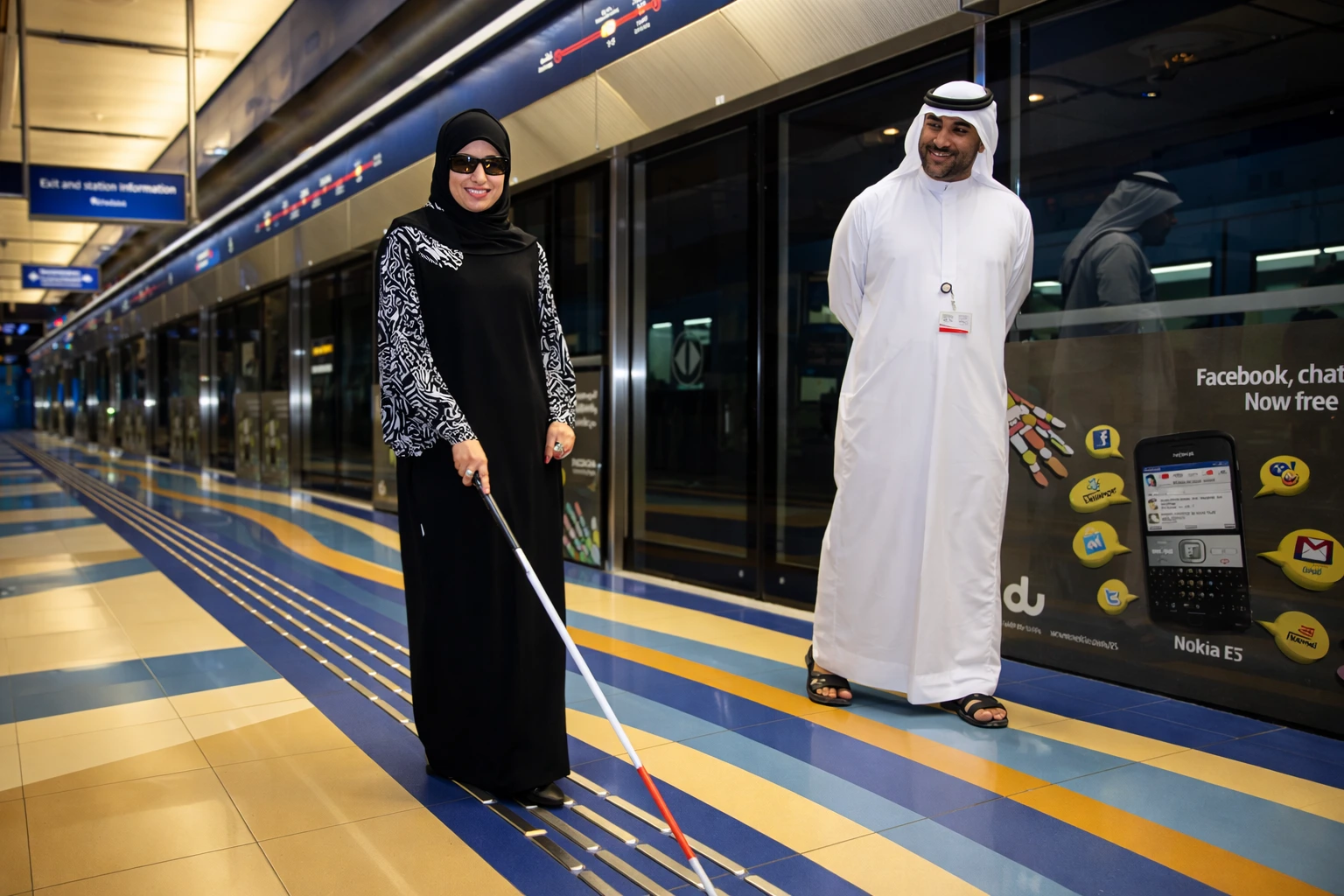
Why we plan the whole route at once
When paving and signage are bought separately, they often point in different directions. A guiding route ends at a wall, or a Braille sign sits by a door the route never reaches.
Planning everything on your drawings first means a visitor can walk from the car park to the counter, and confirm where they are when they arrive. Braille signage and tactile maps follow the wayfinding section of the Dubai Universal Design Code.

Expert Insight
"Paving, signage and Braille are usually sold as three separate items. We treat them as one route, because that is what the person using it experiences. Get the route wrong and it does not matter how good any single tile is."
Nouh Aqra
Founder, Managing Director and Accessibility Consultant, Flex Access
Why Flex Access
Why choose Flex Access for tactile paving in the UAE
Made to your emirate's code
We specify to the Dubai, Abu Dhabi or federal UAE code, not to a foreign catalogue standard.
Accessibility specialists
Tactile paving is part of a full accessibility service, from lifts and ramps to bathrooms and signage.
One team, supply to sign-off
Supply, installation, inspection and handover documents from one UAE company.
Local warranty and aftercare
A 5-year warranty and one UAE contact for repairs and re-fixing.
Case Study
Tactile paving at AG Cars Vehicle Testing Centre, Dubai
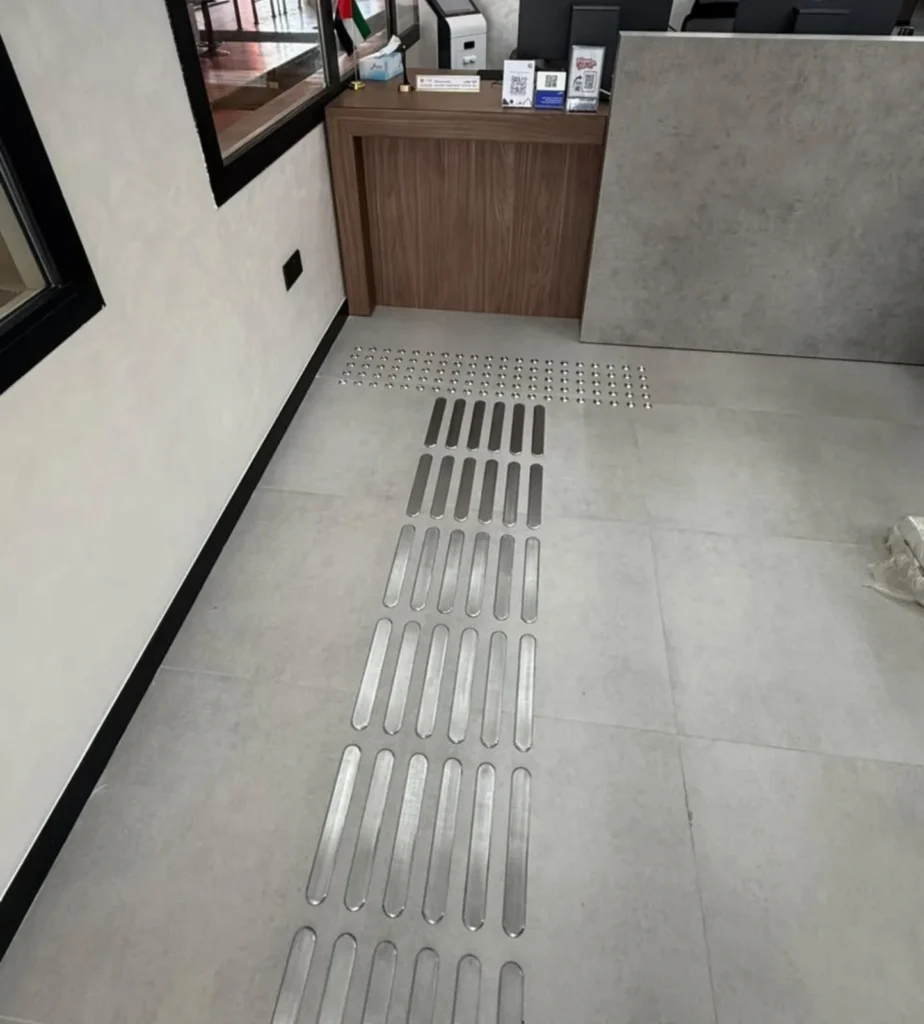
The challenge
No tactile paving inside or out. Visitors with a visual impairment could not find the service counters or tell where the walkway met the vehicle lanes.
What we did
A complete route: yellow tactile paving outside along the walkways and at vehicle crossings, and SS316 stainless steel strips and warning studs inside, leading to the service counters.
The result
Visitors who are blind or have low vision can now reach the counter on their own, on a route that meets the Dubai Universal Design Code.
Explore our latest case studies to see more accessibility projects across the UAE.
Cost
What affects the cost of tactile paving in the UAE?
Every building is different, so we quote after a free consultation. These are the main things that change the price:
Size of the route
How many entrances, stairs, lifts and crossings it covers.
Product and material
PU costs less than porcelain, and stainless steel and brass cost more.
Your floor
New floors, stone, tile, concrete or carpet each need a different method.
Indoor or outdoor
Outdoor routes need heat and UV resistant materials such as SS316.
Signage and maps
Whether Braille signs and tactile maps are part of the project.
Supply or full service
Supply only, or supplied, installed and documented by us.
Get a clear, written quote for your project, with no obligation to go ahead.
Get a Free Consultation and Quote →Service Areas
Tactile paving across the UAE
We supply and install tactile paving in all seven emirates, for government, commercial and private projects.
Frequently Asked Questions
FAQs
What is tactile paving?
Tactile paving is a textured walking surface that people who are blind or have low vision can feel with a cane or their feet. Domes warn of a hazard, and bars guide along a route. It must also contrast in colour with the floor around it.
What does TGSI mean?
TGSI stands for tactile ground surface indicators. It is the technical name for tactile paving used in specifications, tenders and international standards such as ISO 23599.
Which buildings need tactile paving in the UAE?
Public buildings and routes, including government service centres, malls, hospitals, hotels, schools, metro and bus stations, and the sidewalks around them. The exact layout depends on the emirate's code and the building's use.
What are the six types of tactile paving?
UK guidance lists blister, corduroy, two platform edge types, segregated cycle track and guidance path. UAE codes group these into two types: warning paving with domes and directional paving with bars.
Why is tactile paving often yellow?
Yellow stands out strongly on grey paving and concrete, which helps people with low vision see the route. It is not the only colour allowed. What matters is enough contrast with the floor around it, so grey, black or stainless steel can be the better choice on light floors.
Do villas and homes need tactile paving?
Private homes are not usually required to have tactile paving. Many families still add it at entrance steps and outdoor stairs for a relative with low vision.
How much does tactile paving cost in the UAE?
It depends on the size of the route, the product and material, your floor, and whether you need supply only or full installation. We give a written quote after a free consultation, with no obligation.
Who supplies tactile paving in Dubai and Abu Dhabi?
Flex Access supplies and installs tactile paving across Dubai, Abu Dhabi and all seven emirates, specified to the code of each emirate, with supply only or full installation options.
What is the difference between tactile paving and Braille signage?
Tactile paving is on the floor and tells people where to walk. Braille signage is on walls, doors and lifts and tells them where they are. A complete route needs both.
How long does tactile paving last?
Stainless steel and porcelain tactile paving can last many years with basic cleaning. PU lasts well indoors. All our tactile products carry a 5-year warranty.
Written By
Nouh Aqra
Accessibility Consultant and Managing Director at Flex Access, with more than 10 years of experience delivering accessibility and mobility solutions across the UAE, including tactile paving, wayfinding and Braille signage projects reviewed against the Dubai Universal Design Code and Federal Law No. 29 of 2006.
Book your free tactile paving consultation
Tell us about your building. We will check the code for your emirate, plan the route and recommend the right products, then send you a clear written quote.