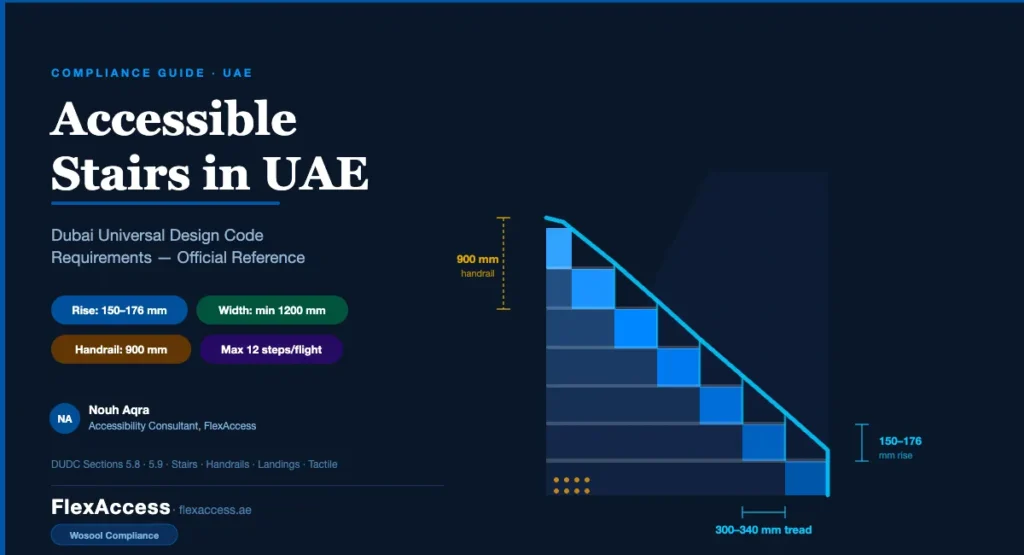
The UAE has made a serious and measurable commitment to making its built environment inclusive. The Dubai Universal Design Code (DUDC), published by Dubai Municipality, is the primary document that governs how public and commercial buildings must accommodate people of determination and other users who depend on consistent, predictable design to move safely.
Stairs are one of the highest-risk elements in any building. Done wrong, they cause falls, restrict access, and expose building owners to compliance failures during the Wosool assessment process. Done right, they become a safe, predictable, and dignified part of the building experience for all users, including the elderly, people using mobility aids, and those with visual impairments.
“In my years working on accessibility audits across Dubai, the staircase is where I find the most violations. Not because designers are careless, but because people underestimate how specific and non-negotiable these requirements are.”
— Nouh Aqra, Accessibility Consultant, FlexAccess
The DUDC is clear: stairs should include as many accessible elements as possible. This is not optional language. Buildings seeking Wosool classification from Dubai Municipality must score at or above 75% (Bronze) or 90% (Gold) on the accessibility checklist, and staircase compliance forms a significant part of that assessment.
About the Dubai Universal Design Code
The DUDC is enforced through Dubai Municipality’s Building Permits Department. All requirements cited in this article come directly from Section 5.8 (Stairs) and Section 5.9 (Handrails) of the official code. Where the Dubai Building Code (DBC) supersedes or adds to the DUDC, we note this explicitly.
Step dimensions
The geometry of a step is fundamental to accessibility. Inconsistent or extreme dimensions increase fall risk for everyone, but especially for people with limited leg lift, balance issues, or visual impairments. The DUDC sets precise numeric boundaries.
The core step dimensions
- Rise height: 150 – 176 mm (Minimum 150 mm, maximum 176 mm per step)
- Tread depth: 300 – 340 mm (For straight flight stairs only)
- Tolerance: ± 4 mm (Max variation between steps in the same flight)
- Nosing projection: Max 25 mm (Ideally avoided entirely)
The rise-tread formula
Beyond the individual dimension limits, the DUDC requires that the relationship between rise (R) and tread (T) satisfies a specific ergonomic formula. This ensures that the walking rhythm is comfortable and predictable:
650 mm < 2R + T < 700 mm
R = rise, T = tread
Figure 1. The DUDC requires every staircase to satisfy this relationship between rise and tread dimensions.
As a practical example: a rise of 160 mm and a tread of 320 mm gives 2(160) + 320 = 640 mm, which falls below the 650 mm minimum. The same rise with a tread of 340 mm gives 660 mm, which complies. Always verify the formula, not just the individual dimensions.
Step uniformity across the flight
Every step in a staircase must have the same height, with a permitted tolerance of no more than ±4 mm. This is critical for people who adapt their gait to a rhythm as they ascend or descend. A single anomalous step, even 10 mm out, causes a disproportionate number of falls. In existing buildings, this is one of the most common violations found during accessibility audits.
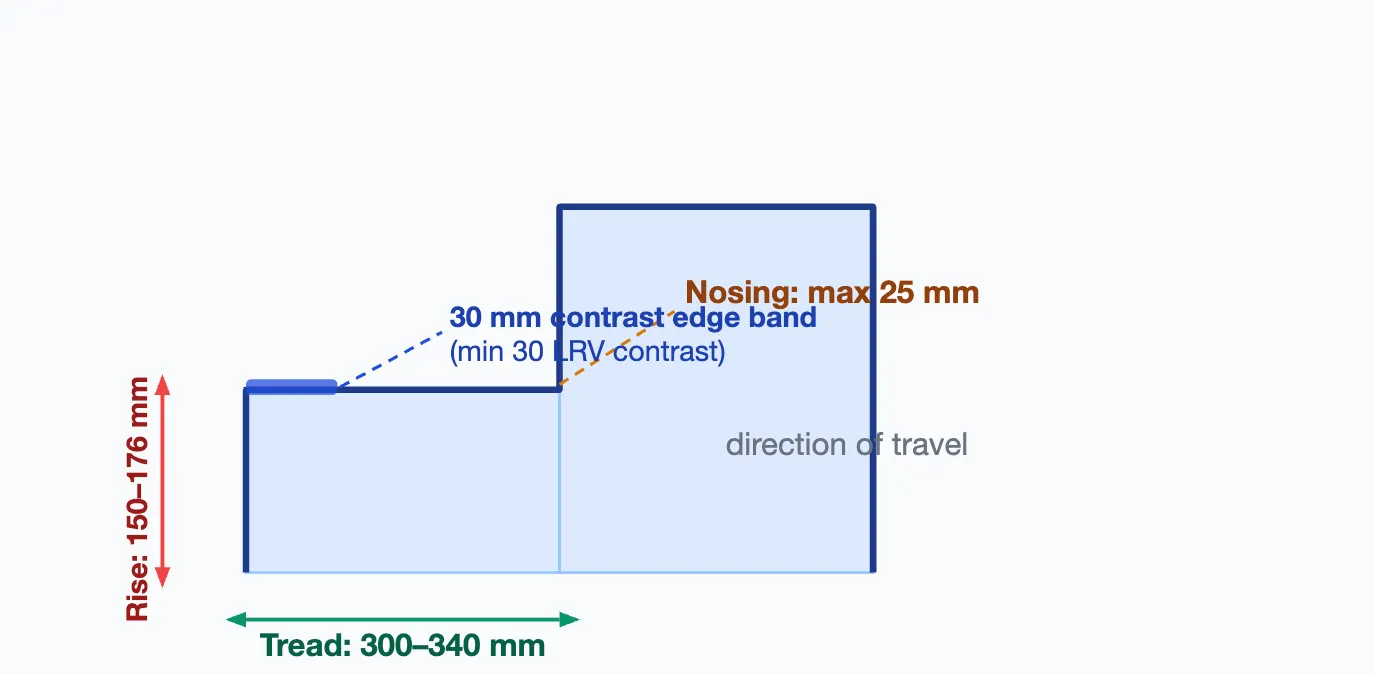
Figure 2. Cross-section of a DUDC-compliant step. All dimensions are mandatory. The contrast band at the step edge is also required.
Step edge contrast
At least 30 mm from the step edge must show a reflectance contrast of a minimum 30 LRV (Light Reflectance Value) points against the step surface. For users with low vision, this contrast band is what defines the edge of each step. Without it, stairs become hazardous.
⚠️ Common site error: Using matching or near-matching tiles for both the tread surface and the contrast band fails this requirement even if a physical nosing strip is present. The 30 LRV difference must be measurable. Many natural stone finishes used in Dubai buildings do not meet this threshold.
Stair flights: width, steps per flight, and lighting
A stair flight is a continuous sequence of steps between landings. The DUDC governs not just individual steps but the entire flight as a unit.
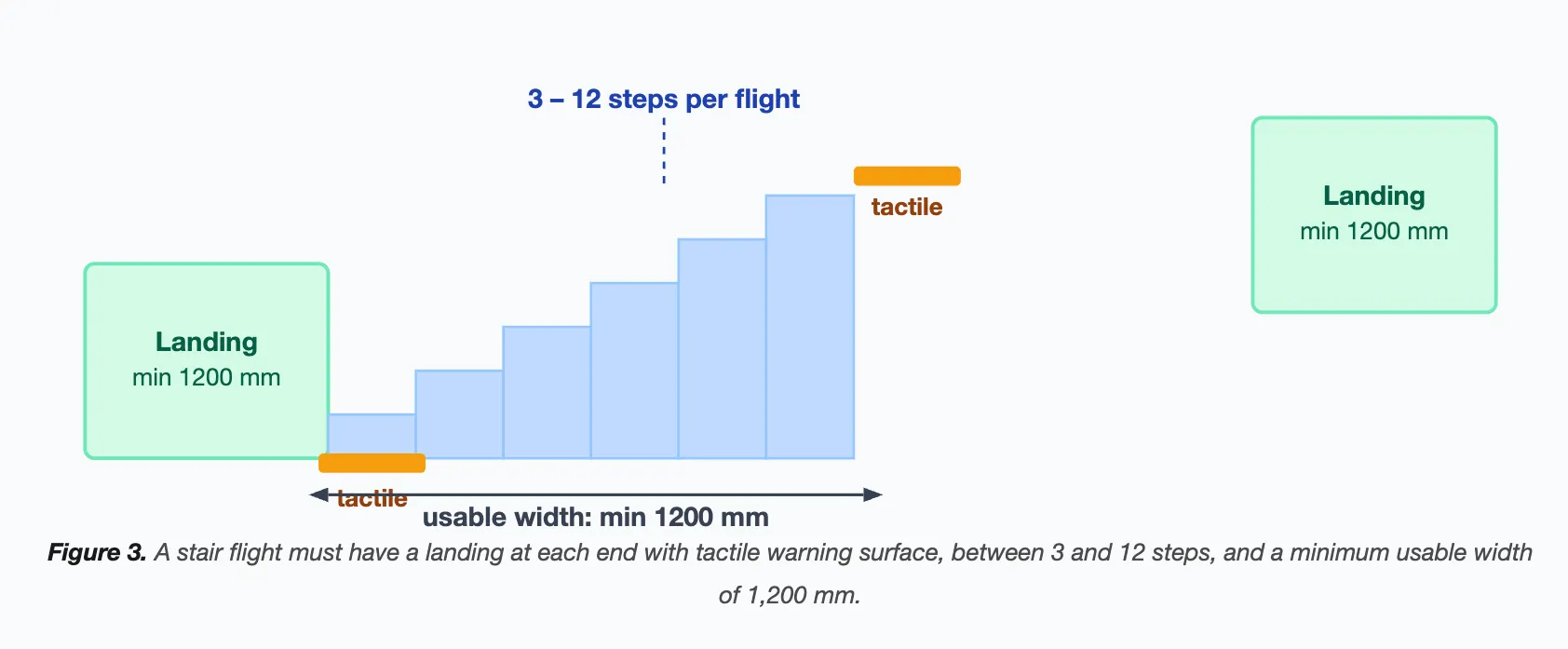
- Min usable width: 1,200 mm (Measured between walls or guardrails)
- Steps per flight: 3 – 12 (Minimum 3, maximum 12 steps)
- Handrail intrusion: Max 120 mm (Per side before usable width is reduced)
- Lighting: 200 lux (Minimum at top, bottom, and along the flight)
Why the 3-step minimum matters?
A flight of fewer than 3 steps creates an ambiguous level change that users, particularly those with visual impairments or attention challenges, can miss entirely. The code requires a minimum of 3 steps to ensure the change in level is perceptible and predictable. For single or double steps, a ramp is the correct solution.
Why the 12-step maximum matters?
More than 12 consecutive steps without a landing increases fatigue and reduces the ability of users to recover if they lose balance. For elderly users and people using walking frames or crutches, a landing is an essential rest point. The maximum of 12 steps is not a suggestion.
Lighting requirements
The DUDC sets a minimum illumination of 200 lux at the top and bottom of each flight and along its full length. In practice, this means dedicated step lighting or ceiling fixtures with calculated lux levels, not just ambient general lighting. This matters particularly in covered outdoor areas, basement car parks, and internal fire escapes which often fall below this threshold.
Landings: size, direction changes, and clearances
Landings interrupt flights of stairs to provide rest points and transition zones. Their design is just as regulated as the steps themselves.
- Landings between flights running in the same direction must maintain at least the same width as the stair and have a minimum length of 1,200 mm.
- When there is a directional change between two flights (e.g. a switchback stair), the landing width must not be reduced at the turn. The full stair width must be maintained.
- Landings must be free of obstacles. No furniture, fittings, fire equipment, or other objects may reduce the effective landing space.
- No door should open directly into a landing in a way that reduces usable landing space. Door swing must be clear of the landing area.
⚠️ Door openings into landings: This is one of the most frequently violated requirements in mid-rise residential and commercial buildings across Dubai. Service doors, fire doors, and plant room doors are often positioned to swing open onto landing space. This is a non-compliance regardless of how rarely the door is used.
Handrails: heights, grip, contrast, and heat
Handrails are the most tactile part of the stair system for users with vision impairments, and the most physically critical element for users with mobility challenges. The DUDC’s requirements here are among the most detailed in the entire stairs section.
When handrails are required on Stairs
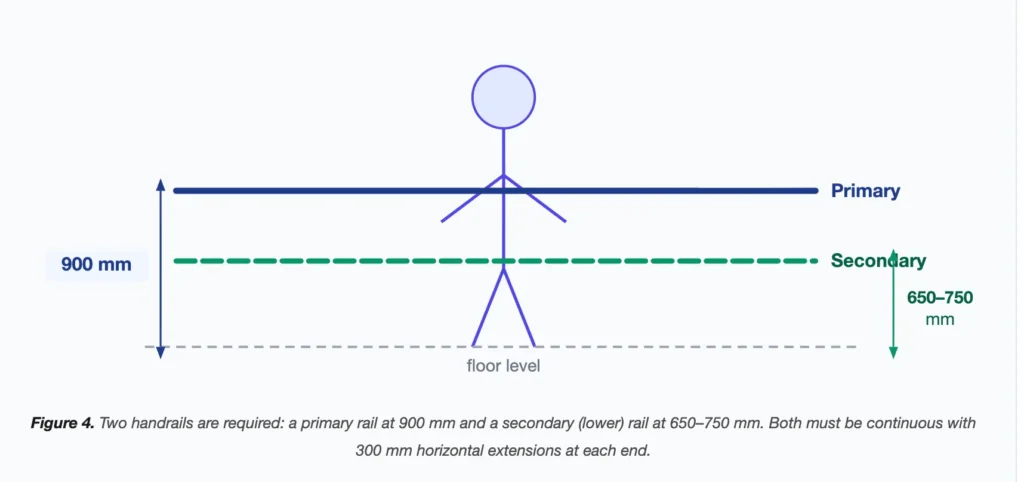
Any stair or ramp with a change in level greater than 500 mm must have continuous handrails on both sides. The handrail must extend 300 mm horizontally beyond the top and bottom of the flight. This horizontal extension allows users to grip the rail before and after the steps, not just during them.
Handrail grip and clearance
- Primary handrail height: 900 mm from floor or step nosing level.
- Secondary handrail height: between 650 mm and 750 mm. Required for children and wheelchair users who benefit from a lower grip point.
- Grip section: circular profile 30–40 mm diameter, or equivalent anatomical gripping surface. A flat plate or rectangular section does not comply.
- Clearance from wall surface: minimum 40 mm. Less than this prevents a full-hand grip.
- Mounting brackets: must not interrupt the continuous gripping surface.
Colour contrast
Handrails must have a reflectance contrast of at least 30 LRV points against their background, whether that is a wall, a void, or sky. A white handrail against a white wall fails this requirement, as does a dark handrail against a dark façade.
Heat exposure: a UAE-specific requirement
This is a requirement you will not find in most international accessibility codes, and it is included in the DUDC specifically for the UAE climate. All handrail materials exposed to direct sunlight must not reach temperatures that can damage users. Metal handrails in direct sun in Dubai regularly exceed 70°C in summer months, which causes serious burns on contact.
✅ Compliant material solutions: Thermally stable polymers, wood composites, or stainless steel with low solar absorptance coatings are among the compliant options for outdoor handrails in UAE. Bare aluminium and painted steel in dark colours are typically the highest risk. If in doubt, a thermal assessment at peak solar exposure hours should be conducted.
Intermediate handrails for wide stairs
When a staircase exceeds 2,100 mm in width, an additional intermediate handrail must be installed. The spacing between intermediate handrails must be no more than 2,100 mm. This applies to monumental, double-loaded, or ceremonial staircases frequently found in UAE hotel lobbies, government buildings, and civic facilities.
Tactile warning surfaces at stairs
Tactile warning surfaces are raised-dot floor indicators that signal a hazard to users who navigate by touch or reduced vision. The DUDC requires them at the beginning and end of every stair flight.
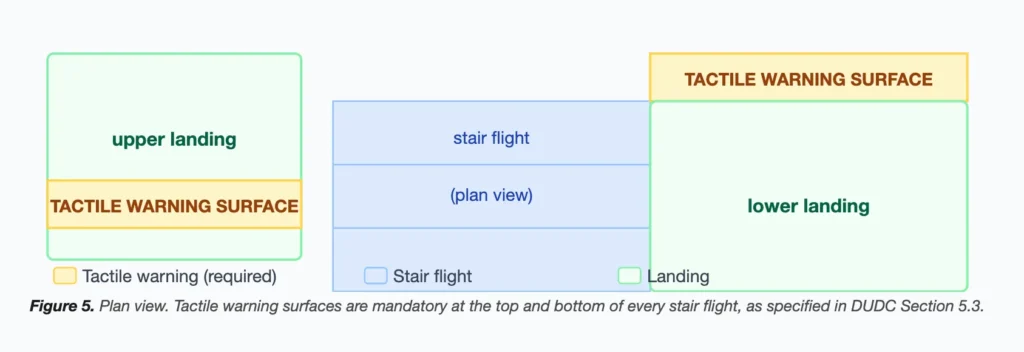
Figure 5. Plan view. Tactile warning surfaces are mandatory at the top and bottom of every stair flight, as specified in DUDC Section 5.3.
What to avoid (open risers, curved stairs, and problematic nosing)
The DUDC is explicit about three design elements that are either prohibited or strongly discouraged in accessible stair design.
Open risers (prohibited)
Open risers, where the vertical face of each step is absent and the gap below is visible, are not permitted. For people with foot drop, spasticity, or limited proprioception, open risers create a serious risk of catching a foot. The code is categorical: no open risers or discontinued treads are allowed.
Curved stairs (to be avoided)
The DUDC states that curved stairs should be avoided. The tapered tread width of a curved stair makes consistent tread depth impossible, and the variable distances from handrail to step edge create confusion for users relying on spatial memory to navigate. Where a curved stair already exists in a building undergoing compliance assessment, careful documentation and possible remediation may be required.
Nosing (limited to 25 mm, ideally absent)
A nosing is the horizontal overhang of a tread over the step below. The DUDC allows a maximum of 25 mm and explicitly states that nosing is not advisable. Protruding nosings are a trip hazard, particularly on descent, and are a leading cause of stair falls among the elderly. Where nosings are used, they must be clearly highlighted with the contrast band requirement.
Wheelchair access (when stairs are not enough)
Accessible stairs, however well-designed, cannot serve wheelchair users. The DUDC is clear that in any building with more than one floor, an elevator, lift, or platform lift must also be provided. Stairs are not a substitute for vertical accessibility, they are a complement to it.
For those asking how to make stairs wheelchair accessible in the truest sense, the answer is that you cannot do so with stairs alone. What you can do is ensure that the stairs are as safe and usable as possible for ambulant users with limited mobility, while a separate accessible vertical route serves full wheelchair users.
ℹ️ Elderly users and stair accessibility: For those asking how to make stairs more accessible for elderly users, the combination of correct rise-tread dimensions, dual handrails at the right heights, non-slip step surfaces with high-contrast edges, sufficient lighting, and a maximum of 12 steps per flight collectively produce the safest possible stair environment for older adults. These are not extras. They are baseline DUDC requirements.
Full compliance summary table
The table below consolidates every numeric and categorical requirement from the DUDC for accessible stairs in one place.
| Element | Requirement | DUDC Reference | Status |
|---|---|---|---|
| Rise height | 150 mm – 176 mm | Section 5.8.1, Item 1 | Mandatory |
| Tread depth (straight flights) | 300 mm – 340 mm | Section 5.8.1, Item 2 | Mandatory |
| Rise-tread formula | 650 mm < 2R + T < 700 mm | Section 5.8.1, Item 3 | Mandatory |
| Step height uniformity | All steps same height, tolerance ±4 mm | Section 5.8.1, Item 9 | Mandatory |
| Open risers | Not permitted | Section 5.8.1, Item 5 | Prohibited |
| Curved stairs | Should be avoided | Section 5.8.1, Item 4 | Avoid |
| Nosing projection | Max 25 mm; ideally absent | Section 5.8.1, Item 7 | Mandatory |
| Step edge contrast band | Min 30 mm width, min 30 LRV contrast | Section 5.8.1, Item 8 | Mandatory |
| Steps per flight | 3 minimum, 12 maximum | Section 5.8.2, Item 2 | Mandatory |
| Usable flight width | Min 1,200 mm | Section 5.8.2, Item 3 | Mandatory |
| Handrail intrusion into width | Max 120 mm per side | Section 5.8.2, Item 4 | Mandatory |
| Lighting along flight | Min 200 lux top, bottom, and throughout | Section 5.8.2, Item 5 | Mandatory |
| Tactile warning surface | At start and end of every flight | Section 5.8.2, Item 1 | Mandatory |
| Landing length (same direction) | Min 1,200 mm | Section 5.8.3, Item 1 | Mandatory |
| Landing (direction change) | Full stair width maintained, obstacle-free | Section 5.8.3, Item 2 | Mandatory |
| Handrails: when required | Both sides, level change > 500 mm | Section 5.9, Item 1 | Mandatory |
| Handrail horizontal extension | 300 mm at top and bottom ends | Section 5.9, Item 1 | Mandatory |
| Intermediate handrail | Required if stair width > 2,100 mm | Section 5.9, Item 2 | Mandatory |
| Primary handrail height | 900 mm | Section 5.9, Item 4 | Mandatory |
| Secondary handrail height | 650 mm – 750 mm | Section 5.9, Item 4 | Mandatory |
| Grip diameter | 30 mm – 40 mm circular | Section 5.9, Item 5 | Mandatory |
| Wall clearance | Min 40 mm from wall surface | Section 5.9, Item 5 | Mandatory |
| Handrail LRV contrast | Min 30 LRV points against background | Section 5.9, Item 6 | Mandatory |
| Outdoor handrail heat | Must not reach harmful temperatures | Section 5.9, Item 7 | Mandatory |
Common mistakes we see in UAE buildings
- Step height variation across a flight: The first and last steps of a flight are often poured or finished differently from the middle steps. On many sites we audit, the bottom step is 10 to 20 mm shorter than the rest of the flight, compensating for ground level tolerances. This violates the ±4 mm uniformity rule.
- Missing secondary handrail: The dual handrail requirement, with a lower rail at 650–750 mm, is one of the most widely missed requirements. Many architects and contractors only install one handrail at 900 mm and consider the stairs complete.
- Marble and polished stone without contrast bands: High-end residential and hotel developments in the UAE frequently specify marble or polished granite for their statement staircases. These materials, in their standard finishes, rarely meet the 30 LRV contrast requirement at step edges. A contrasting insert or treatment is required.
- Handrails that end at the top step: The 300 mm horizontal extension requirement at both ends of the handrail is regularly omitted. Handrails that terminate exactly at the top or bottom riser leave users without support at the most critical transition point.
- External handrails that become dangerously hot: Stainless steel and painted metal handrails on south or west-facing outdoor stairs in the UAE are routinely non-compliant with the thermal requirement. We have measured surface temperatures on standard stainless steel handrails exceeding 75°C in July afternoons.
Frequently asked questions
How do I make stairs accessible for wheelchair users?
A staircase itself cannot provide full accessibility for wheelchair users. The DUDC requires that any multi-floor building also provides an elevator, lift, or platform lift. Well-designed accessible stairs serve ambulant users with limited mobility. For wheelchair users, a separate accessible vertical route is mandatory.
What is the maximum rise height for accessible stairs in UAE?
The Dubai Universal Design Code sets the maximum rise height at 176 mm and the minimum at 150 mm. All steps in a flight must also be within 4 mm of each other.
Do all stairs in UAE need to be accessible?
The DUDC applies to public buildings, commercial buildings, and multi-family residential buildings. The Wosool certification program applies to existing buildings as well. Private single-family villas follow different guidelines. If you are unsure whether the DUDC applies to your building, FlexAccess can advise.
What is LRV and how is it measured for stair edges?
LRV stands for Light Reflectance Value, a measure of how much light a surface reflects on a scale from 0 (absolute black) to 100 (pure white). The DUDC requires a minimum 30-point difference between the step surface and the contrast band. LRV is measured using a spectrophotometer or referenced from manufacturer data sheets.
Can I use a stair lift instead of an elevator?
Stair lifts and inclined platform lifts can be considered as retrofit solutions in existing buildings where full elevator installation is not feasible. Whether this is acceptable for your building type depends on your specific DUDC and Dubai Building Code provisions and should not be decided without a professional accessibility assessment.
How many steps before a landing is required?
A maximum of 12 steps is permitted in any single flight before a landing is required. The landing must be at least 1,200 mm long and the same width as the stair, free of obstacles and door swings.
What width do accessible stairs need to be in UAE?
The DUDC requires a minimum usable width of 1,200 mm for accessible stair flights. This is the clear width between walls or guardrails, as long as handrails do not protrude more than 120 mm from the wall.
Need a stair accessibility audit or design review?
FlexAccess conducts accessibility compliance assessments for new and existing buildings across the UAE, including staircase audits aligned to the Dubai Universal Design Code and Dubai Building Code. Whether you are preparing for Wosool certification, reviewing construction drawings, or retrofitting an existing facility, we can help.